
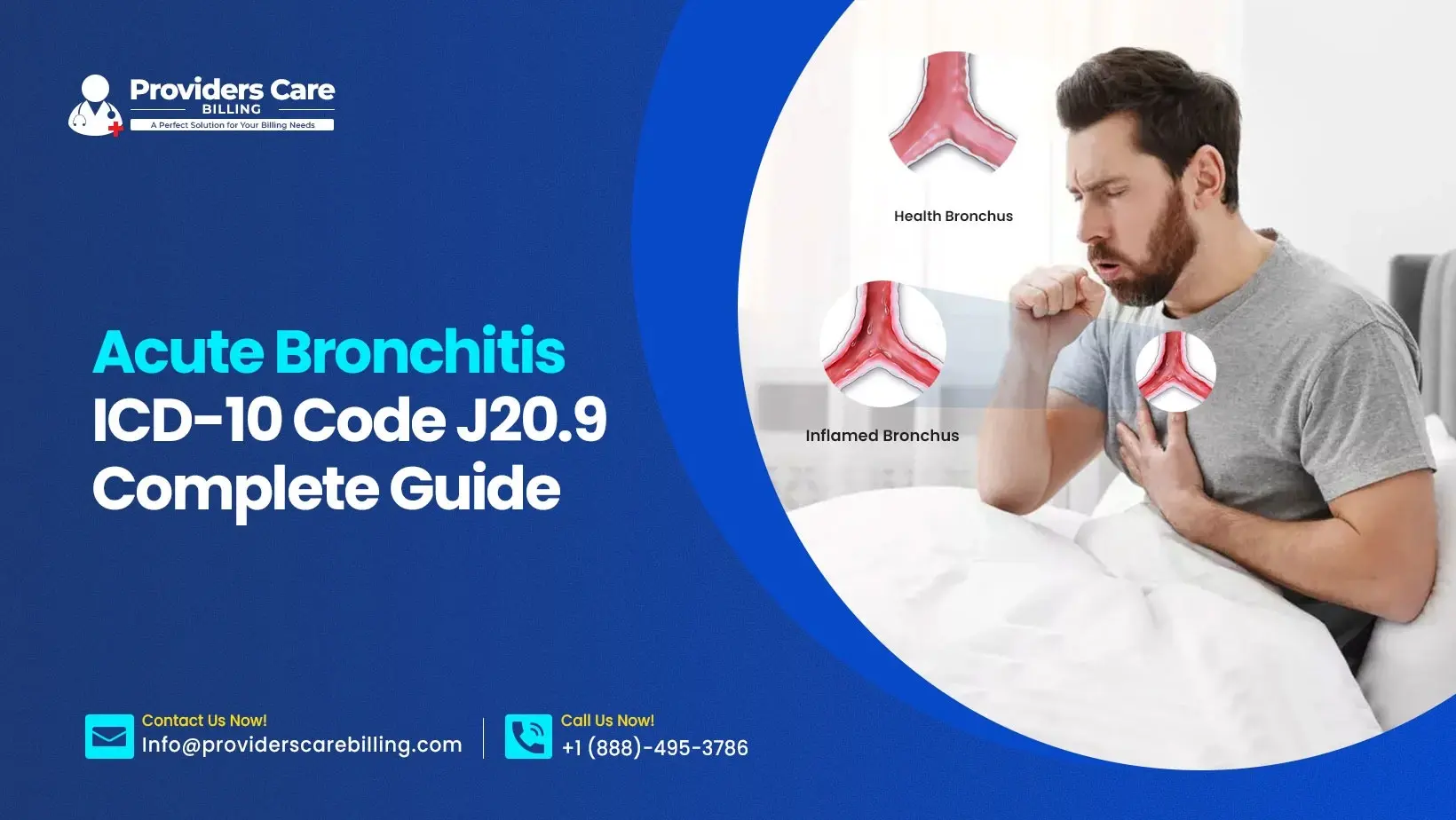
One of the most frequent coding medical billing diagnoses of respiratory diagnosis is Acute Bronchitis ICD-10 code (J20.9). Since the diagnosis is completed in millions of outpatient visits annually in the United States, it is important that you are aware of how to use ICD-10 J20.9 to receive the appropriate reimbursement, to draft clean claims, and to adhere to payers.
ICD 10 Code for Acute Bronchitis
J20.9 ICD-10 – Acute bronchitis, not specified.
This code will be used in case you suspect that your patient has acute bronchitis, but you cannot identify a particular cause of bronchitis or a particular cause of bronchitis-causing agent.
Definitions:
- J20.9 ICD-10 acute bronchitis; un-specified.
- J20.9 is identical to J20.9, but slightly different.
- It is a very critical code of billing and documentation. It is the most acceptable and generalized classification of unspecified bronchitis in the outpatient section.
What Is Acute Bronchitis?
In most cases, acute bronchitis is the inflammation of the bronchial tubes caused by a virus. It typically presents with:
- Persistent cough
- Mucus production
- Chest discomfort
- Mild fever
- Fatigue
Most of the cases are carried out in 1 -3 weeks. For more detailed medical guidance, refer to CDC guidelines for acute bronchitis.
Acute vs Chronic Bronchitis
| Conditions | Category ICD-10 | Key Difference |
| Acute bronchitis | J20 series | Acute inflammation, short-term. |
| Chronic bronchitis | J41-J42 | Chronic and mild inflammation. |
| Bronchiolitis | J21 | Small airway inflammation. |
This awareness of these differences would be applied to avoid the inappropriate diagnosis of bronchitis.
Acute Bronchospasm and Related Conditions ICD-10 Code of Acute Bronchospasm
Acute bronchitis can be present in the presence of rhinitis, bronchospasm, or reactive airway symptoms. When recording, they should be recorded differently.
Acute bronchospasm ICD‑10 code:
- J98.01 – Acute bronchospasm.
Coders may also append either or both codes in case a provider documents bronchospasm and bronchitis.
Associated coding searches: It may be significant to also use associated coding searches:
- ICD-10 also includes acute bronchospasm; it is important when it comes to the description of respiratory infection.
- The acute bronchitis ICD-10 code is obligatory for the proper diagnosis and treatment.
- The documentation should never be ignored before an additional respiratory diagnosis is made.
Acute Bronchitis vs Acute Bronchiolitis ICD-10 Coding
The main problem with the coding is the distinction between bronchitis and bronchiolitis. J21 is acute bronchiolitis, and this condition is common in children of infancy and young children, whereas bronchitis is common in a broader age group.
Search terms to use:
- Acute Bronchitis ICD-10 code
- ICD-10 acute bronchiolitis code.
- bronchiolitis ICD‑10 code
Coders are not supposed to use bronchiolitis codes unless it is a specific code written by the provider. For further coding guidance, see our ICD-10 Codes for Respiratory Diseases
Viral Bronchitis ICD‑10 Coding
Because of the fact that most acute bronchitis cases are viral, coders tend to encounter:
- viral bronchitis ICD‑10
- ICD‑10 Acute Bronchitis
In case a certain virus has been identified, it should include an organism-specific code (J20), not J20.9. Otherwise, use ICD‑10 code J20.9.
ICD-10 Coding Problems Asthmatic Bronchitis
Bronchitis can also develop in asthma patients. The most common search terms are the ICD-10 codes of acute bronchitis and pneumonia:
- Asthmatic bronchitis ICD‑10
Firstly, in such situations, code asthma, then bronchitis, if it is documented. The strategy will guarantee adequate interpretation and reimbursement by payers.
ICD-10 of Chronic Bronchitis
Coders also have to differentiate between acute and chronic bronchitis. Common searches include:
- ICD 10 diagnosis of Chronic Bronchitis.
Chronic bronchitis is included in the classification of J41 and J42 and must not be mistaken with acute bronchitis codes. A common cause of denial is using a different chronic code for acute bronchitis (ICD 10).
ICD-10 Coding Tracheobronchitis
Tracheobronchitis is another ailment related to it. Common search term:
- ICD 10 tracheobronchitis
This diagnosis can be coded separately on the basis of documentation. Always go through provider notes.
ICD-10 Coding of Acute Bronchitis: Requirements of Documentation
Correct coding and reimbursement are supported by proper documentation. Providers should document:
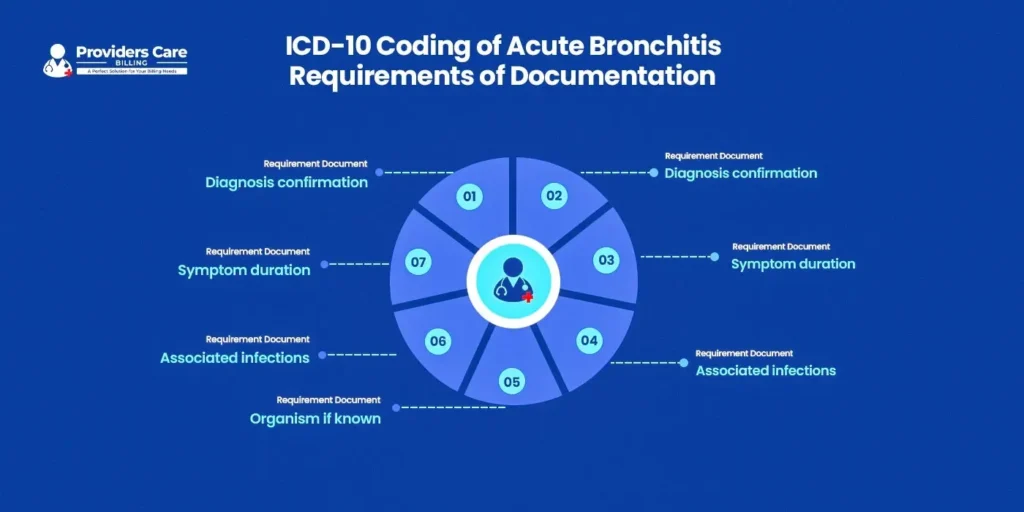
- Diagnosis confirmation
- Symptom duration
- Associated infections
- Organism if known
- Bronchospasm if present
- Smoking history is relevant
- Treatment provided
Poor documentation compels the coders to adopt unspecified diagnosis, which can lead to risks during an audit. Consider leveraging medical billing services for enhanced accuracy.
CPT Code of Acute Bronchitis
No acute bronchitis CPT code exists since CPT is a description of services, but not diagnoses. Rather, CPT relies on services rendered, including billing and documentation for respiratory infections:
- Office visits
- Chest X‑rays
- Breathing treatments
- Lab testing
Pairing of CPT with ICD-10 code J20.9 is required to get payment.
The Future Trends on ICD-10 Bronchitis Coding
The coding in healthcare is still developing. Emerging trends include:
- AI coding audits
- Real-time documentation checks are essential for accurate coding for acute bronchitis.
- Automated denial alerts help healthcare providers manage claims related to acute bronchitis.
- Predictive coding tools
The practices that will enhance the code outcomes include practices of investing in these tools.
Bronchospasm and Asthmatic Bronchitis (ICD-10)
Code the asthma when bronchitis is overlapping. Enter J45 asthma codes, and append bronchitis in case it is reported.
- ICD‑10 for Bronchospasm
Use J98.01 for acute bronchospasm. Appealing claims require proper sequencing.
- Viral Bronchitis ICD‑10 Coding
Specific codes are to be used in case a viral cause is reported, e.g.:
- J20.3 viral bronchitis
- J20.4 parainfluenza
Otherwise, use J20.9.
The most frequent coding errors in ICD-10 Code J20.9
Errors during the coding of bronchitis cases occur among even experienced coders. Common mistakes include:
- Entering J20.9 in case the organism is documented.
- Diagnosis of bronchospasm absence.
- Coding symptoms as opposed to a verified diagnosis.
- Misunderstanding between acute bronchitis and chronic bronchitis.
- Incorrect use of bronchiolitis.
- Incorrect CPT linkage
These mistakes cause unwarranted rejections and revenue delays.
How Denial Management Enhances the Bronchitis Coding Outcomes
Medical billing comprises strong denial management that can correct the coding problems in a very short time. Effective denial management is concerned with:
- Root cause analysis
- Documentation review
- Coding corrections
- Appeal submission
- Education of providers
This enhances compliance and revenue cycle performance.
The way Medical Coding Services increase Accuracy
Professional Medical Coding Services assist the providers:
- Choose the right ICD-10 codes.
- Review documentation
- Reduce denials
- Improve coding compliance
- Optimize reimbursement
In the case of Providers Care Billing LLC, to ensure respiratory diagnoses, including acute bronchitis, are coded appropriately, expert coding review is combined as a part of the overall medical billing services in Illinois and Revenue Cycle Management Services.
The contribution of Revenue Cycle Management towards respiratory coding
High healthcare revenue optimization relies on:
- Accurate diagnosis coding
- Clean claim submission
- Coding audits
- Denial tracking
- Documentation training
These processes minimize mistakes on claims of acute bronchitis using ICD-10.
Ensure that your reimbursements are not affected by errors in coding.
ICD-10 coding, documentation checking, credentialing, comprehensive revenue-cycle services, etc. Professional help is able to alter the manner in which you bill, whether you like it or not. Contact us today!
Conclusion
In order to clean the claims, accelerate the reimbursement, and conform to regulations, the acute bronchitis ICD-10 code of J20.9 should be properly coded.
Although bronchitis might appear clear-cut, coding flaws can result in refusal to pay, delay, and revenue losses. Providers can also contribute to positive financial performance by making proper documentation, making an appropriate choice of diagnosis, and using efficient coding procedures. Working with billing and coding specialists will increase accuracy and efficiency during the revenue cycle. Your practice will be able to minimize denials, enhance, and maximize collections with confidence with the expert help of Providers Care Billing LLC.
FAQs
What do you know about the meanings of the ICD-10 code of acute bronchitis?
J20.9 is the most commonly coded. The diagnosis of acute bronchitis is made, and no identifiable organism is determined.
In which cases can ICD-10 Code J20.9 be implemented?
Code J20.9, which is bronchitis of unspecified etiology, is applied in cases of bronchitis in the patient, but the organism is not denoted.
What can be done to decrease the mistakes connected with the coding of J20.9?
Record all the data needed, use the most accurate ICD -10 code that exists, and check your coding process before submitting claims to prevent placing the claim in jeopardy.
What can be done to avoid coding errors of J20.9?
Additional ways of minimizing coding errors include good documentation, the choice of specific ICD-10 codes where possible, and checking claims before submission.
What do you know about the difference between acute and chronic Bronchitis?
Acute bronchitis is classified under the J20 series, and chronic bronchitis is classified under the J41-J42.