If you work in a cardiology practice and are managing billing for one, then you already know how complicated things can get. You’re not just keeping your patient in good care and managing the practice’s finances. There are a lot of other things that are going on between them. And when it comes to cardiac electrophysiology billing, coding becomes more complex. Because even a small mistake can cause claim denials. It also leads to audits and revenue lost.
That’s why understanding the right CPT codes and how to use them is so important. In this article, we’ll break down all this information in simple wording. So, no confusion is left behind. It is practical information that clinics and hospitals can use across the U.S.
What is Cardiac Electrophysiology?
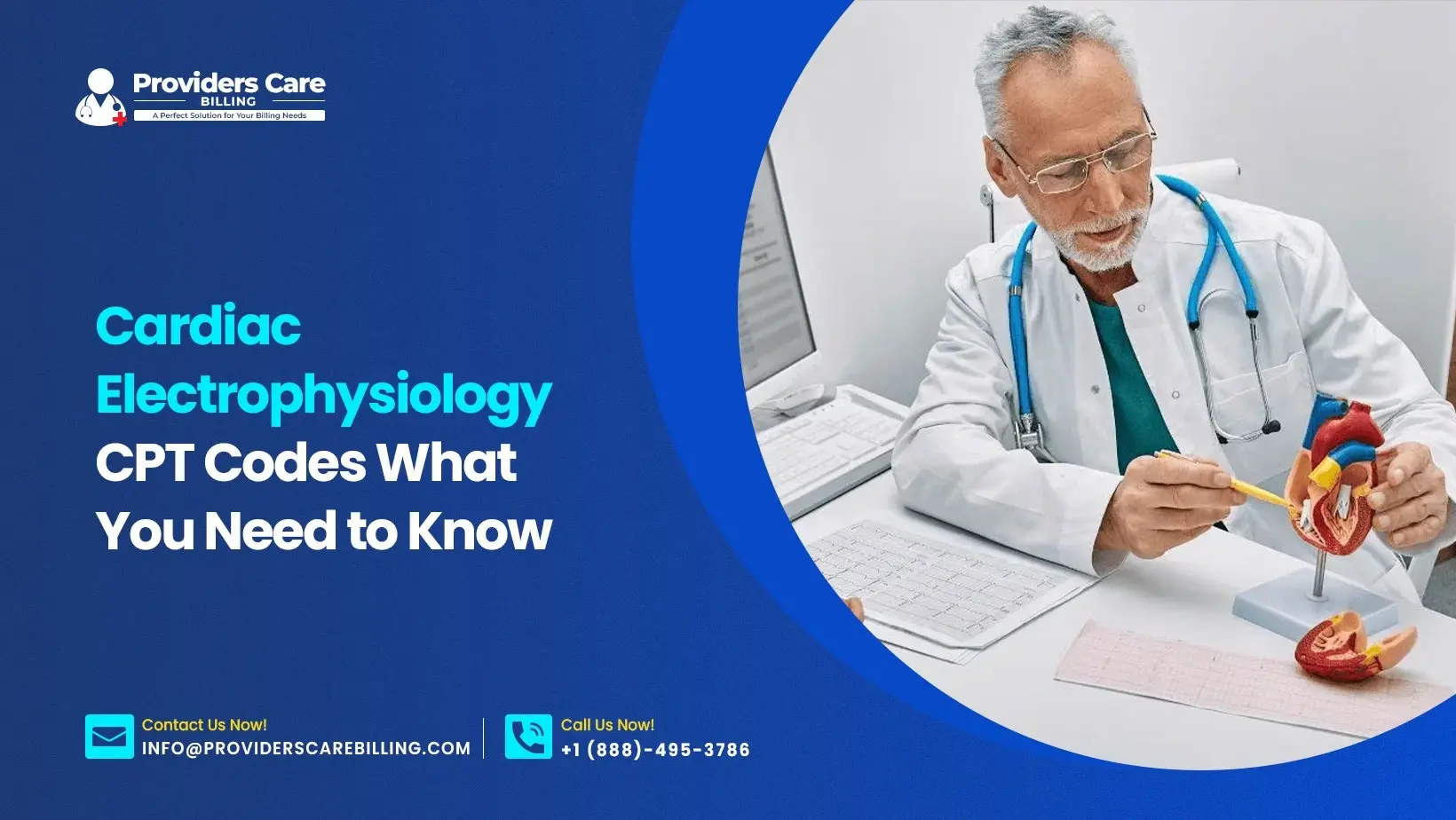
It is a study of how electrical signals move through your heart. As we know, the human heart beats because of a carefully timed series of electrical impulses. But when those signals go haywire, they can cause irregularities that are named as arrhythmias. And the list of problems which it includes is atrial fibrillation, tachycardia, bradycardia, and other cardiac disorders. Specialists use advanced tools and testing methods to identify these conditions.
An electrophysiologist is a cardiologist. They have specialized training in heart rhythm disorders. But some people mistakenly refer to these specialists as an electrical physiologist. But we want to make it clear that the correct medical term is electrophysiologist.
Today, EP Cardiology plays a major role. It sits at the intersection of high-tech diagnostic and precision treatment. It helps to reduce stroke risks and improve patient outcomes. And because these procedures are both complex and costly. However, correct medical billing and coding are absolutely important.
What Is Clinical Cardiac Electrophysiology?
Many providers also ask this question. In simple terms, it refers to the full scope of a patient’s care. We can say that it starts with initial evaluation and testing, then treatment, and then follow-up. All that falls under the electrophysiology specialty.
But in practical terms, it means your team is performing everything from ECGs and EKGs to catheter ablations and pacemaker implants. All of these services need to be billed accurately. To better understand specialty billing workflows, you can also read our Cardiology Medical Billing Services guide.
The Core CPT Code Categories for EP Procedures
Electrophysiological procedures are reported using a specific range of codes.
Diagnostic EP Studies (CPT 93600–93624)
These codes are used when the electrophysiologist maps the heart’s electrical pathways. The purpose of this is to identify the source of an arrhythmia. So, you can think of it as “detective work” before treatment begins.
Some key codes that are included in this range are:
- CPT 93600: It is for a bundle of His recordings.
- CPT 93618: Next comes the code for programmed stimulation to evaluate arrhythmias.
- CPT 93620: the third for intraventricular pacing and recording.
These are diagnostic, which means that they’re used to gather information. But not to treat the problem directly. And the most important thing is to document each component carefully. Because bundling rules in this area are strict.
Ablation Therapy: The CPT Code for Cardiac Ablation
Once the doctors have diagnosed the problem, they start treating it. And that’s where ablation codes come into play. Most commonly used CPT codes for cardiac ablation are 93653 and 93656.
The cardiac ablation code 93656 is widely used for comprehensive electrophysiologic evaluation. It is also combined with catheter ablation of atrial fibrillation. So if you’re looking for the CPT code for atrial fibrillation ablation procedures, 93656 is the one to know. This code covers a lot of ground. It includes right atrial pacing, recording, and the actual ablation. That’s why it is considered a comprehensive code.
Mapping and 3D Systems (CPT 93613, 93660)
The modern EP labs often use advanced three-dimensional mapping systems to guide procedures. The first CPT 93613 covers intracardiac electrophysiologic 3D mapping. And CPT 93660 is used to evaluate the sinus node. These can be reported as primary codes or as add-ons. But it depends on the clinical situation.
ECG and EKG CPT Codes Explained
Electrocardiograms are among the most common tests in cardiology. And yet ECG and EKG CPT codes still trip people up all the time.
The CPT code for an EKG is 93000. It is specifically a routine 12-lead electrocardiogram. This covers both the tracing and the interpretation. If only the interpretation is provided (without the technical component), you can use 93010. And if only the tracing is done without the reading, then 93005 is applied.
So when someone asks you about the CPT code for electrocardiogram, the answer depends on what’s actually being performed. The EKG code 93000 is the most complete version. Because it covers the whole service. And yes, EKG and ECG have the same code. Both these terms are used interchangeably in billing and clinical settings.
Pacemaker CPT Codes: What You Need to Know
It covers a wide range of services. It starts with the initial implant and extends to routine follow-up checks. CPT 33206–33249 covers various types of pacemaker and ICD implantation procedures. But it depends on whether the device is single-chamber, dual-chamber, or biventricular.
For in-person device evaluations, healthcare providers use codes like 93279–93299. They use it to bill for checking and testing devices such as pacemakers and ICDs. During these visits, the physician or technician reviews the working of the device. They check the battery status and also make sure that the patient’s heart rhythm is stable.
When it comes to remote monitoring, it works a little differently. Instead of visiting the clinic, the patient’s device sends data electronically from home. In these cases, codes like 99091 and certain Medicare G-codes may be used. It helps to report the monitoring and review of patient data.
Critical Coding Rules You Can’t Ignore
Now, here’s where a lot of practices run into trouble. There are some very specific rules around EP coding that aren’t always obvious.
Bundling Restrictions
It is a big one. If a diagnostic electrophysiology study and a catheter ablation are both performed separately. If they are done during the same session, you generally cannot bill separately for the diagnostic study. The comprehensive ablation codes already include the diagnostic evaluation. The only exceptions are when the parenthetical guidelines from the AMA explicitly allow separate billing. And those guidelines need to be reviewed carefully.
Add-on codes
It is another area that requires close attention. There are certain components of EP procedures that can sometimes be reported in addition to the primary code. It includes left atrial recording (CPT 93621) or right ventricular pacing (CPT 93623). But only when the documentation strongly supports medical necessity.
Moderate sedation
This billing is also separately reportable in some cases. When the performing physicians manage the sedation themselves, codes are used. It includes CPT 99151, 99152, and the add-on code 99153 may also apply. But these are based on the patient’s age and the total time involved.
How Providers Care Billing LLC Can Help?
At Providers Care Billing LLC, we understand the unique challenges involved in cardiology and EP billing. Our experienced team provides:
- Cardiology medical billing
- Electrophysiology coding support
- Revenue cycle management (RCM)
- Claims submission and follow-up
- Insurance verification
- Denial management
- Compliance monitoring
We work with healthcare providers, clinics, hospitals, and physician groups across multiple US regions. It includes Texas, Florida, California, New York, and many others. Our specialized billing professionals stay up to date on changing payer guidelines and CPT coding updates to help practices improve revenue performance. And cardiology practices can also explore internal services such as:
- Cardiology billing services
- RCM solutions
- ICD-10 coding support
- Prior authorization assistance
- Denial management strategies
Are you ready to Improve Your Cardiology Billing Process?
You can contact us today and schedule a free consultation call. During this, you’ll know about how our expert medical billing services can help your practice to improve revenue and streamline cardiac electrophysiology billing workflows.
FAQs
What is the CPT code for cardiac electrophysiology?
It doesn’t have just one or a specific one. Because EP billing uses a whole range of CPT codes. It ranges from 93600 to 93662. But the right code depends on what procedure was performed.
What is cardiac electrophysiology in cardiology?
It is a cardiology subspecialty that focuses on diagnosing and treating abnormal heart rhythms. And is caused by electrical signal problems in the heart.