

The OA 23 Denial Code is one of the most common claim adjustment codes that healthcare providers encounter. They interact with it when dealing with multiple insurance plans. In simple terms, this code indicates that a previous payer has already processed the claim and made an adjustment or payment that affects the current claim balance.
So, understanding the OA 23 denial code reason, its impact, and the proper resolution steps is very important. It helps providers reduce denials and, as a result, improve cash flow. After that, knowing how to handle coordination of benefits (COB) issues is essential for medical practices, physicians, and hospitals.
In this guide, we’ll explain everything you need to know about the denial code OA 23. It includes causes, solutions, prevention strategies, and billing best practices.
What Is the OA 23 Denial Code?
It means that the payer has adjusted your claim. Because a prior payer has already processed and reimbursed the service. The “OA” stands for “Other Adjustment” and most commonly appears in Coordination of Benefits (COB) situations, where a patient has more than one insurance plan. According to the CMS guidelines on Coordination of Benefits (COB), insurers follow specific rules to determine payment responsibility when multiple health plans are involved.
The key thing to understand is that when you see the OA-23 denial code on your explanation of benefits (EOB), it doesn’t automatically mean someone made a terrible mistake. It simply means the payment was reduced because of what a previous insurance plan had already paid. And in most cases, neither the patient nor the practice is personally responsible for the remaining balance. The payment was just adjusted based on the prior payer’s adjudication.
In fact, if you’re wondering what OA 23 means on an EOB. This is exactly like the secondary or tertiary payer’s way of saying, ‘We’ve already accounted for what the primary insurance paid. The OA 23 denial code description also appears under Medicare and Medicaid claims. So if you’re dealing with an OA 23 Medicare denial code or a Medicaid denial code OA 23, the core meaning stays the same.
Common Causes of the OA 23 Denial Code
Now that we know what it means, let’s talk about why the denial code OA 23 actually shows up. There are a few usual suspects here.
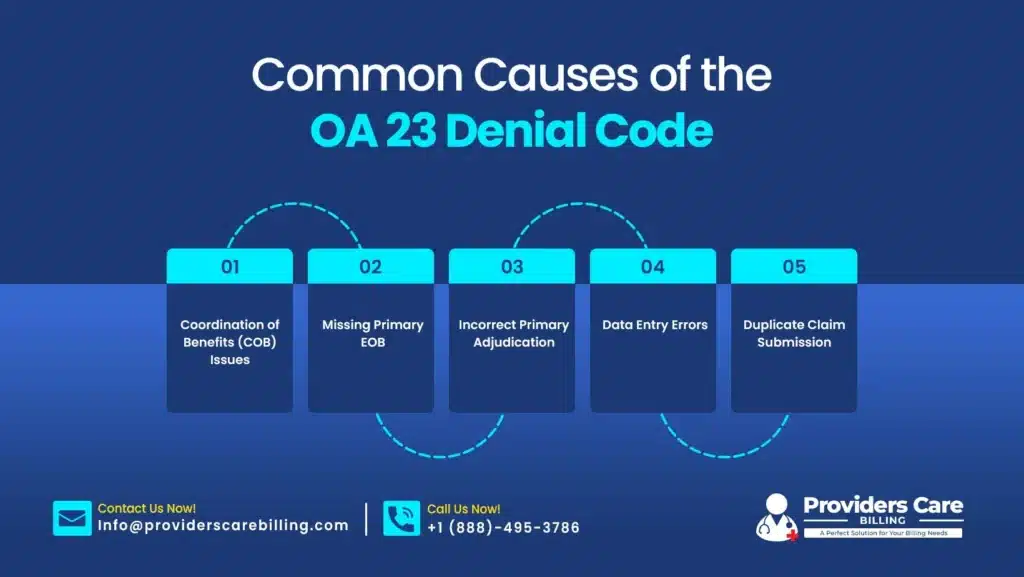
Coordination of Benefits (COB) Issues
It is one of the most common causes that shows incorrect COB information. It appears that when a patient has both a primary and a secondary insurance plan. And the secondary payer needs to know exactly what the primary paid before it can process its share. If that information isn’t clearly documented or correctly applied, the secondary insurer will adjust the claim. And that’s where the denial code reason comes in.
Missing Primary EOB
This is also a very common trigger. It arises when the secondary insurer doesn’t receive the original Explanation of Benefits or Electronic Remittance Advice (ERA) from the primary payer. And in this situation, they simply have no idea of what was already paid. And without that data, the claim gets flagged.
Incorrect Primary Adjudication
Sometimes the primary insurance company makes an error during its claim processing. It includes incorrect payment calculations, coding mistakes, or adjustment errors that can create downstream issues for secondary claims. As a result, the secondary insurer may generate an OA23 remark code or apply an OA23 adjustment.
Data Entry Errors
Now comes the simple billing mistakes, which can also contribute to this denial. And the errors that can cause include incorrect policy numbers, patient information, claim amounts, or insurance sequencing. They can trigger claim adjustments during the coordination of benefits review.
Duplicate Claim Submission
Finally, duplicate claims can cause this issue as well. If your billing software accidentally submits the same claim twice, the system may flag the second one with the 23 denial code to indicate the service was already addressed.
COB Solutions and Quick Fixes for the OA 23 Denial Code
Here’s where things get practical. Let’s walk through the OA 23 denial code and action steps you should take right away.
Step 1: Verify the Primary EOB and COB Data
Before anything else, you need to pull up the primary insurance’s EOB and carefully review it. After that, check whether the reimbursement amount, the contractual adjustment, and any patient responsibility, like coinsurance, were all calculated correctly. And this is your starting point for any OA 23 denial code resolution.
Step 2: Resubmit with the Primary EOB Attached
If you’re submitting the claim electronically to a secondary payer, first make sure the primary payer’s EOB or ERA information is properly attached or mapped into the electronic claim file. But if you’re going the paper route with a CMS-1500 form, then attach the primary EOB directly to the submission. Because only this single step resolves a surprisingly large number of OA 23 denials.
Step 3: Audit for Coding and Charge Errors
In this step, first double check your procedure codes, modifiers, and billed charges. Make sure that everything matches exactly what the primary insurer adjudicated. Because any discrepancy here can cause the secondary payer to flag the claim with an OA23 remark code or deny it outright. And this is a critical step in your overall OA 23 denial code solution.
Step 4: Scrub for Duplicate Claims
During this step, run a check to ensure the first claim hasn’t already been processed. If it was paid correctly, then the secondary denial might simply reflect that existing payment, which is actually fine. However, if the second claim was mistakenly labeled as a duplicate, you’ll need to contact the payer directly. And you’ll request that one of the claims be correctly reprocessed.
How to Prevent OA 23 Denials from Happening in the First Place?
We understand that fixing denials is important. But preventing them is even better. That’s why there are a few smart habits that can significantly reduce the frequency of denial.
Double check Your Insurance Sequence
We always suggest cross checking the insurance sequence before services are rendered. Use your eligibility and benefit verification systems to confirm which plan is primary and which is secondary. Because if you get this wrong from the start, this will be one of the fastest ways to trigger a COB denial.
Training Your Staff
Billing teams should understand payer rules, COB requirements, and documentation standards. And they should be trained to submit complete data every single time. That means always attaching primary remittance data when forwarding claims to the secondary payer. It sounds simple, but it’s one of those things that gets skipped under pressure. And it causes a ton of unnecessary denials.
Use Claim Scrubbing Tools
Also, track your EOBs consistently. For this, use clearinghouse portals or your medical billing software to identify missing data and potential claim errors before submission. These tools improve first pass claim acceptance rates and reduce denials.
Partner with Experienced Billing Experts
There are many healthcare organizations that outsource their revenue cycle tasks to professional Medical Billing Services providers. Because experienced billing specialists can monitor claim trends and identify recurring issues. As a result, improve your reimbursement performance.
At Providers Care Billing LLC, we work with doctors, clinics, hospitals, and physicians across the country. It includes practices in Texas, Florida, California, New York, Georgia, and many other states. We help them to reduce denials like OA 23 and maximize their revenue. Our expert team handles everything from medical billing services and medical coding services to full Revenue Cycle management (RCM).
Conclusion
Are you dealing with the OA 23 denial code or any other recurring denial that doesn’t have to drain your time and resources?
Contact us at Providers Care Billing LLC today or schedule a consultation call and find out how our team can help you reduce denials. So, don’t let OA 23 or any denial code stand between your practice and the reimbursement you’ve earned.
FAQs
What does the OA23 denial code mean?
The OA23 denial code means that a claim has been adjusted by a payer. Because a prior (primary) payer has already processed and reimbursed the service. The OA stands for ‘Other Adjustment.’ And it commonly appears in Coordination of Benefits situations where multiple insurance plans are involved.
What is the adjustment code OA 23?
OA 23 is an adjustment code that is used by secondary or tertiary payers. It indicates that the payment on a claim has been affected by a prior payer’s adjudication.
What is the denial code COB 23?
COB 23 refers to a denial or adjustment that is related to Coordination of Benefits. When a patient has more than one health insurance plan, COB rules determine which plan pays first (primary). And how much the secondary plan is responsible for.
What is the 23 modifier in medical billing?
It is different from the OA 23 denial code. The modifier 23 indicates ‘Unusual Anesthesia’. It’s used when a procedure that typically requires local or no anesthesia needs general anesthesia due to unusual circumstances. It’s attached to anesthesia procedure codes and signals to the payer that the case was medically complex.