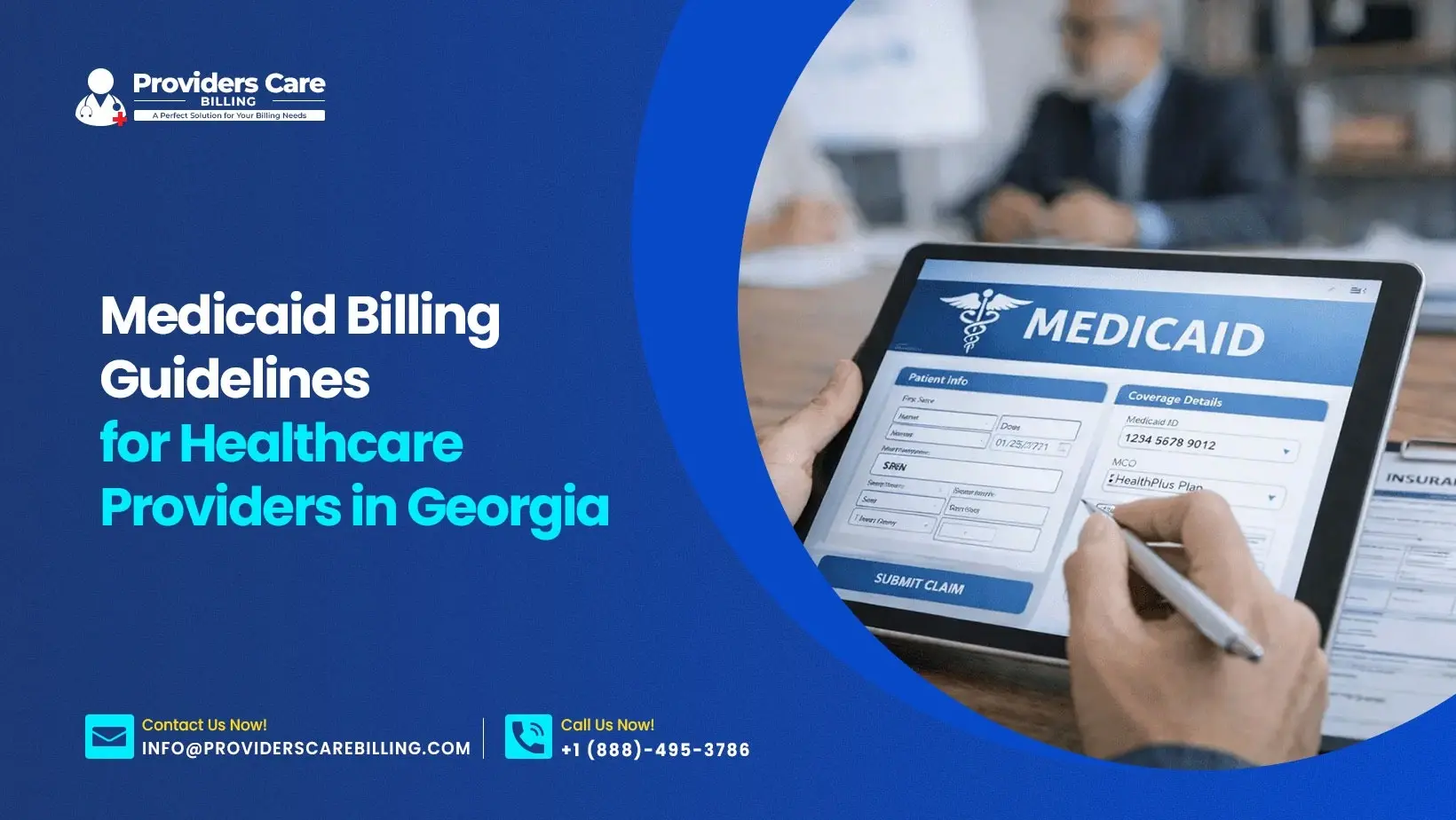
Every healthcare provider in Georgia knows one fact: billing Medicaid is not a simple task. From the enrollment steps to coding requirements, filing deadlines, and continuously changing rules, it feels so complicated. But do not worry about it. Because our guide breaks it all down in simple and easy terms.
So, if you are a physician, clinic, or hospital, you should know the Medicaid billing guidelines in Georgia to keep your practice financially strong. So let us discuss step by step.
What is Georgia Medicaid, and Who Does it Cover?
It is a program that is run by both the U.S. and the state of Georgia. The DCH manages it to cover a wide range of people, including low-income earners, pregnant women, families, seniors, and people with disabilities.
Due to the Affordable Care Act, the Medicaid Georgia expansion, and ongoing changes, more Georgians now qualify for Medicaid coverage. It means more patients and more billing work for providers like you.
Georgia Medicaid runs on two main systems
- First is the Fee-for-Service (FFS) model, where the state pays you directly for each service.
- Second are Managed Care Organizations (CMOs). It is where patients join programs such as Georgia Families, offered by private partners including Amerigroup, CareSource, Peach State, and WellPoint.
Knowing which system your patient has is the very first step to a successful Medicaid claim submission in Georgia.
Georgia Medicaid Provider Enrollment: Your First Step
Before you bill Georgia Medicaid for a claim, enroll yourself as an approved provider. This requirement is a must, and skipping it is one of the common Medicaid billing mistakes in Georgia. And the enrollment happens through the GAMMIS portal, which involves the following steps:
- Firstly, you have to submit your National Provider Identifier (NPI) and taxonomy codes
- Then give your credentials and practice documentation
- After that, complete the Georgia Medicaid provider enrollment application on the GAMMIS portal
- If your patient is in the Georgia Families managed care program, you should also separately credential and contract with the proper CMO.
The Georgia Medicaid billing requirements for new providers take time, so enroll early, much before you see Medicaid patients. On approval, you can start submitting claims through the system.
How to Submit Medicaid Claims in Georgia Step-Wise
After being enrolled, you know exactly the right way of submitting Medicaid claims in Georgia. If you make mistakes, there is a higher chance of denials, delayed payments, and extra work. You should keep the following things in mind.
Electronic Claim Submission Is Required
Use electronic methods for Georgia Medicaid claim submission. You can do it either by the GAMMIS portal or via an approved clearinghouse with standard EDI (Electronic Data Interchange) formats. Paper billing is mostly not acceptable. So make sure your practice management software supports e-filing.
Know Your Timely Filing Deadlines
According to the updated Georgia Medicaid billing rules 2026, it is important to stay on top of your filing deadlines. For standard Fee-for-Service Medicaid, you have almost 95 days from the service date to file an initial claim. But, in some situations, such as retroactive eligibility or Coordination of Benefits (COB) cases, you may have up to 12 months.
Missing deadlines is the main reason claims get denied. So always be careful about deadlines and resubmit any late claims with proper documentation if allowed.
Always Verify Patient Eligibility First
Before any service, always verify the patient’s Medicaid eligibility. It can be through the Georgia Gateway Portal or the GAMMIS system. And checking eligibility regularly protects you from being billed for non-covered services. It also helps prevent unnecessary denials in the future.
Get Prior Authorizations When Required
Some treatments, therapies, and medical equipment need prior authorization (PA). You must request and get a PA before the service. Providing this service without PA is a mistake that leads to costly claim denials.
Handle Third-Party Liability the Right Way
Georgia Medicaid is always the payer of last resort. It means if a patient has any other insurance, including Medicare, you must bill that primary insurance first.
After you get the Explanation of Benefits (EOB) or the primary payer’s remittance advice, send it with your Medicaid claim to get the remaining coverage.
Coding Requirements and Georgia Medicaid Billing Services Compliance
The usage of correct medical codes is necessary for Georgia Medicaid billing compliance. All claims must comply with the state’s HCPCS and CPT coding guidelines. Incorrect or mismatched codes can lead to claim denials and audits.
A few coding tips are as follows:
- Use the latest ICD-10 diagnosis codes for every claim
- Match CPT codes to what is in the patient’s medical record
- Do not upcode or undercode. Because both have compliance issues
- Reference the official Georgia DCH Provider Manuals for program-specific coding rules
Do not forget to check the GAMMIS Public Access Fee Schedules for current Medicaid reimbursement rates Georgia. Because understanding of Georgia Medicaid reimbursement rates 2026 enables your practice to plan finances accordingly.
What are the Common Medicaid Billing Mistakes in Georgia (And How to Avoid Them)?
Even skilled providers make billing errors. Some common Medicaid billing mistakes in Georgia are:
Mistake 1: No verification of patient eligibility before each visit
Mistake 2: Missing claim filing deadlines
Mistake 3: Submission of claims with no required prior authorizations
Mistake 4: Using incorrect or old CPT or ICD-10 codes
Mistake 5: Not billing the primary payer first for dual coverage
Mistake 6: Not joining the correct CMO network for managed care plans
So, strong internal processes avoid all these mistakes. Also, with the help of a professional billing team that knows Georgia Medicaid billing guidelines inside and out, the chances of errors are reduced.
Do You Want Help Navigating Medicaid Billing Guidelines in Georgia?
If yes, then don’t waste your time. You can partner with us at Providers Care Billing, LLC. We’re the most trusted medical billing company in Georgia. Our expert team handles everything from Medicaid claim submission and denial management to provider enrollment and full revenue cycle management, so you can focus on patient care. Schedule a consultation with us in a few clicks today. Book your Appointment today
Georgia Medicaid Denial Management: What to Do as a Medical Billing Service Provider in Georgia
Even with the best preparation, some claims will be denied. It is normal. So, you should know how to handle Georgia Medicaid denial management in such a way that you recover much revenue.
In case of a denied claim, you should carefully review the reason given for the denial in the Remittance Advice (RA). The most common reasons are eligibility issues, missing prior authorizations, coding errors, and violations of timely filing requirements.
Next, fix the issue and resubmit the claim or file a formal appeal with the GAMMIS system. You need to act quickly on denials, as the most appealing deadlines are strict. This is where dedicated medical billing services in Georgia come in handy. Because a professional billing team simplifies the entire process for you.
Because dealing with the complexities of Medicaid billing guidelines in Georgia for providers takes skill and experience. And this is what Providers Care Billing, LLC offers. As the leading Georgia medical billing company, we offer reliable medical billing and coding services in Georgia to healthcare providers. We also provide to other states, such as Florida, New York, Massachusetts, South Dakota, and Texas and more. Our team is always up to date on all Georgia Medicaid billing rules for 2026, so your practice does not have to be.
Final Thoughts
It seems impossible to know and follow Medicaid billing guidelines in Georgia, but it is not. The right knowledge, processes, and billing partner will submit cleaner claims, reduce denials, and keep your revenue flow smooth.
No matter if you are a new provider just starting with Georgia Medicaid billing requirements or an established practice wanting to improve your billing efficiency, staying informed and proactive is a must.
The rules keep changing, especially with updates to Georgia Medicaid reimbursement rates in 2026 and evolving Affordable Care Act Medicaid provisions in Georgia, so always have an expert team by your side to achieve positive outcomes.
FAQs
What are the Medicaid billing guidelines in Georgia?
According to Medicaid billing guidelines in Georgia, providers should be actively enrolled through the GAMMIS portal before submitting claims. It should meet the state’s CPT and HCPCS coding standards, verify patient eligibility before each visit, get the required PA, and always bill other primary insurance.
What is the timely filing limit for Medicaid claims in Georgia?
For regular Fee-for-Service Medicaid, providers normally have 95 days. It can be from the service date to submit the initial claim. In some cases, such as retroactive eligibility or Coordination of Benefits (COB) claims, it may take up to 12 months.
How to be a Medicaid provider in Georgia?
To be a Medicaid provider in Georgia, first of all, enroll through the GAMMIS portal run by the Georgia Department of Community Health (DCH). You will start with the submission of your National Provider Identifier (NPI), taxonomy codes, and supporting credentials. For managed care plans like Georgia Families, you have to separately contact the related Care management Organization (CMO).
How long does it take to get approved for Medicaid in GA?
The Georgia Medicaid provider enrollment approval times vary. For individual providers, it can take anywhere from a few weeks to a few months, depending on your application volume and processing volume.
We strongly recommend starting the enrollment process early. Working with expert Medicaid billing services in Georgia speeds up the process by making all documentation complete.