

A single wrong place of service (POS) code can reduce reimbursement, lead to an audit, or pay delay; however, it is one of the most misconceived aspects of medical billing. According to industry statistics, POS errors have been the cause of outpatient claims being denied in a significant number, with providers confusing POS 11 vs POS 22.
The distinction between POS 11 and POS 22 is very important to compliance, proper reimbursement, and long-term revenue stability. In Providers Care Billing LLC, professionals regularly witness practices losing thousands of dollars just by choosing the incorrect CMS place of service code. This is a practical guide that provides simple and useful information supported by practical experience in the billing process and correct POS coding.
What does POS mean in Medical Billing?
Place of Service is an acronym that is used in medical billing. Healthcare services are given in relation to POS codes. For the official CMS Place of Service Codes, see the CMS guidelines.
CMS Standardized place of service codes are used to identify:
- Facility and non-facility claim.
- The level of reimbursement of a provider.
- Adherence to payer and Medicare regulations.
Incorrect POS in medical billing may also result in denials or underpayments despite the proper CPT and ICD-10 codes.
CMS Place of Service Codes: An Overview
There are a lot of settings listed as the official CMS place of service codes. Some commonly used POS codes include POS 11 and POS 22, which are crucial for accurate billing:
- 11 – Office is a non-facility POS code that should be used accurately to avoid audit exposure.
- 21 – Inpatient Hospital.
- 22 – Outpatient Hospital.
- 24 – Ambulatory Surgical Center.
This paper dwells upon the most commonly mixed comparison, POS11 vs POS22.
What Is Place of Service 11? (POS Code 11 Explained)
11 Place of Service Code- Office Setting
Place of service code 11 is applied in instances when services are done at the office of a physician who is:
- Privately owned or leased.
- Not hospital‑based.
- Accountable for overhead costs.
What Is POS 11?
POS 11 suggests a non-facility environment, and it is important to use POS codes accurately for proper billing.
POS 11 Description
- Higher reimbursement rates.
- The Provider meets the operational costs.
- Typical of individual practices.
POS11 Medical Billing Typical Cases
- Family medicine clinics.
- Specialty offices that are independent.
- Group practices.
Another common and costly error that can be committed in medical billing is the incorrect use of POS11, particularly in areas that are owned by the hospital.
What Is the Place of Service 22? (POS Code 22 Explained)
Hospital Outpatient Department 22 Place of Service
Place of service 22 is applicable in a hospital outpatient setting where the services are provided.
What Is the Place of Service 22?
POS22 = Outpatient care based on facilities.
POS 22 Description
- The hospital owns the facility.
- The hospital charges an establishment fee.
- Bill by the physician for only professional services.
22 Common POS in Medical Billing -Localities
- Hospital outpatient clinics.
- Provider‑based departments
- The off-campus hospital facilities.
Since the hospital is billed differently, POS 22 in medical billing tends to decrease physician reimbursement.
POS 11 vs POS 22: The Major differences explained
| Feature | POS 11 | POS 22 |
| Setting | Physician Office | Hospital Outpatient |
| Ownership | Provider | Hospital |
| Facility Fee | No | Yes |
| Reimbursement | Higher | Lower |
| CMS Classification | Non- Facility | Facility |
| Audit Risk | Moderate | High in case of miscoded |
This is the difference between proper Revenue Cycle Management.
Why Are POS 11 and POS 22 Important in Medical Billing?
POS 11 and POS 22 are particularly significant when submitting claims to the Medicare and Medicaid insurances on outpatient services in the hospital, since POS data is utilized by CMS to establish:
- A claim is either a facility or a non-facility.
- Calculation of reimbursement.
- When a facility fee (including G0463) is provided.
- Compliance risk and exposure to audit risk.
- POS rules may vary by state; see our New York Medical Billing Services for details.
POS 11 vs POS 22: Impact of Reimbursement
CMS assumptions:
- POS 11: Overhead with provider/reimbursement increased.
- POS 22: Facility fee paid to hospital – decreased professional payment.
Wrong place of service (11 vs 22):
- The wrong place of service may result in overpayments. This is avoided by using POS 11 and POS 22 correctly.
- Underpayments.
- Audit exposure can increase significantly if the billing process does not adhere to correct POS coding.
21 POS in Medical Billing vs POS 22
The other source of confusion is 21 POS in medical billing:
- 21 place of service = Inpatient hospital.
- 22 place of service = Outpatient hospital.
Claims are frequently denied immediately when 21 POS are used to make outpatient encounters.
Medical billing POS 24 is not identical to POS 22
Ambulatory Surgical Centers (ASCs) are covered by POS 24 in medical billing:
| POS Code | Description |
| 22 | Hospital Outpatient |
| 24 | Ambulatory Surgical Center |
These codes cannot be interchangeable and are highly controlled by payers.
Most Frequent POS Coding Errors
- Applying POS code 11 in hospital-owned clinics.
- Use of POS code 22 in standalone offices.
- POS is not updated after acquisitions or changes of location.
- POS and credentialing discrepancies.
Preventing these mistakes is one of the major tasks of the professional Medical Coding Services.
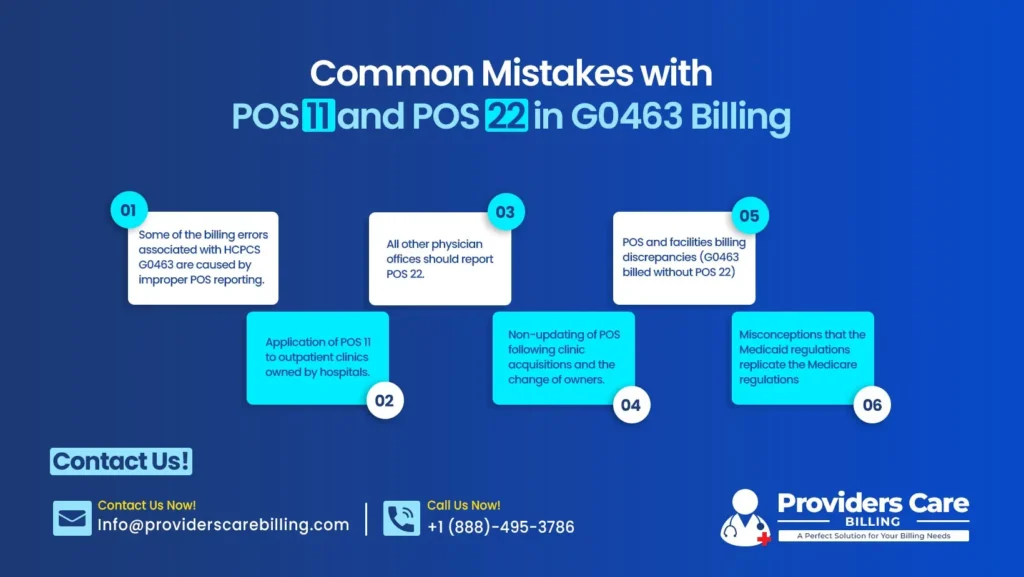
Common Mistakes with POS 11 and POS 22 in G0463 Billing
- Some of the billing errors associated with HCPCS G0463 are caused by improper POS reporting.
- Application of POS 11 to outpatient clinics owned by hospitals.
- All other physician offices should report POS 22.
- Non-updating of POS following clinic acquisitions and the change of owners.
- POS and facilities billing discrepancies (G0463 billed without POS 22)
- Misconceptions that the Medicaid regulations replicate the Medicare regulations.
These mistakes interfere with the billing cycle, break the appropriate codes, and often lead to denied and downcoded claims.
How to Select the Right POS Code
The following questions should be asked prior to filing claims:
- Who owns the facility?
- Who bills the facility fee when using POS 22 for outpatient services?
- Does the provider have the status of a hospital employee?
- What is stated in the payer contract?
As far as compliance and reimbursement are concerned, correct post codes secure both.
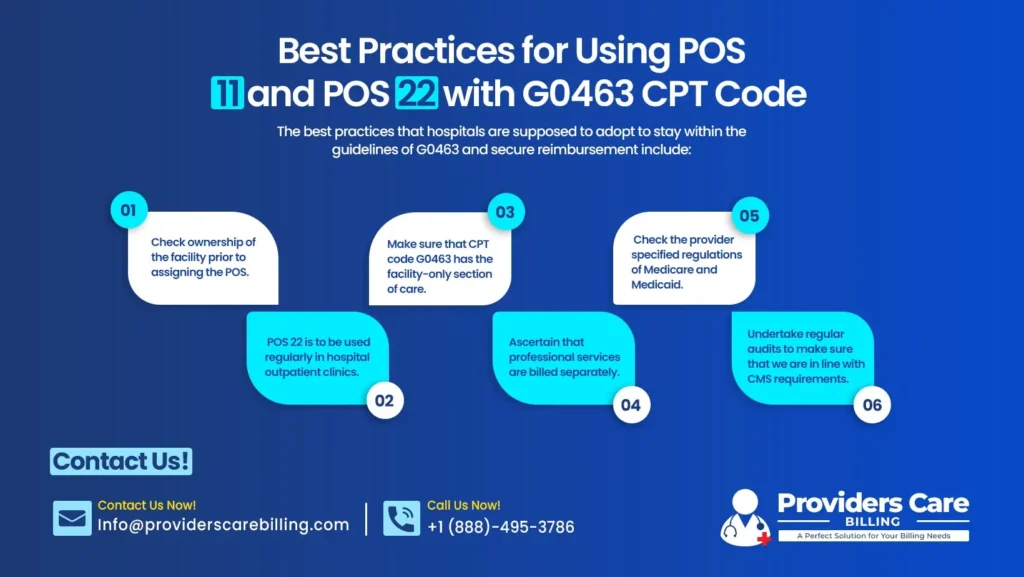
Best Practices for Using POS 11 and POS 22 with G0463 CPT Code
The best practices that hospitals are supposed to adopt to stay within the guidelines of G0463 and secure reimbursement include:
- Check ownership of the facility prior to assigning the POS.
- POS 22 is to be used regularly in hospital outpatient clinics.
- Make sure that CPT code G0463 has the facility-only section of care.
- Ascertain that professional services are billed separately.
- Check the provider-specified regulations of Medicare and Medicaid.
- Undertake regular audits to make sure that we are in line with CMS requirements.
By following these steps, compliance is enhanced, and G0463 outpatient clinic visits to hospitals are correctly and defensibly billed.
The importance of Accurate POS Coding to Revenue Cycle Management
Correct place of service codes has a direct influence on:
- Clean claim rates.
- Audit readiness.
- Cash flow stability.
Well-developed Revenue Cycle Management Services ensure that POS coding is consistent in accordance with the CMS regulations, payer contract, and credentialing
information.
Key Features of POS 11 and POS 22 in Medical Billing for Hospital Outpatient Services
It is important to know the differences between POS 11 and POS 22 in billing G0463 in case of a hospital outpatient clinic visit. Reimbursement, classification of claim, and CMS mandate depend on the place of service (POS).
POS 11 (Office):
– is a non-facility environment.
– Typically applicable to physician offices that are independently owned.
– No facility fee is billed
– Increased professional reimbursement.
– Unsuitable for the majority of the hospital outpatient services.
POS 22 (Hospital Outpatient):
– Is a facility-based environment.
– Applied in outpatient clinical visits at the hospital.
– The hospital registers a facility fee based on HCPCS G0463.
– Physicians charge the professional management service only.
– Under CMS inspection/site-neutral payment regulations.
Say goodbye to POS errors and secure your income.
Collaborate with a reliable Medical Billing Services provider that is aware of the CMS regulations, payer requirements, and practical billing issues.
Accurate coding. Faster payments. Stronger compliance. Get Started Now!
Conclusion
It is crucial to understand POS11 vs POs22 in medical billing to ensure proper reimbursement, compliance, and financial health in the long term. A single misplaced place of service code may reverse weeks of clinical practice and subject a practice to audit.
Possible errors in the POS can be avoided, rather than being expensive, with well-developed Medical Billing Services, Medical Coding Company support, and built-in Revenue Cycle Management Company processes. The Providers Care Billing LLC assists healthcare providers to remain compliant, receive payments correctly, and dedicate their time to patient care rather than billing headaches.
FAQs
What is the place of service 11?
This is the services that are rendered in the office of a physician, which is not owned by the hospital.
What is the place of service 22?
Applied to hospital outpatient departments.
Is POS22 less reimbursed than POS11?
Yes. The cost of facilities at POS22 normally decreases professional reimbursement.
Are the wrong POS codes capable of leading to audits?
Yes. The POS inconsistencies are closely monitored by CMS and commercial payers.