

A claim is made appropriately. The coding is accurate. Documentation is complete. But the payment is rejected with a simple message: “COB information required.
This one problem alone results in thousands of dollars of delayed reimbursements annually to a number of healthcare providers in the United States. The knowledge of COB in medical billing is not a luxury anymore; it is the key to financial and legal security.
Providers Care Billing LLC assists medical practices in negotiating various payer regulations, such as the Health Insurance Portability and Accountability Act (HIPAA), the Medicare Secondary Payer statutes, and the changing insurance regulations. This new 2026 guide answers the questions of what coordination of benefits is in medical billing, how the process of coordination of benefits goes on, and how your practice can keep expensive denials at bay.
What Is COB in Medical Billing?
COB medical abbreviation is the short form of Coordination of Benefits. It is defined as the mechanism that insurance companies adopt in making decisions on payment responsibility whenever a patient has more than one active health insurance policy.
COB in medical billing is simply the organized process of medical billing, which defines who will be the first (primary) and the second (secondary) payer. It makes sure that the reimbursement shall not be over and above 100 percent of the allowable amount. This avoids the possibility of payment being missed, and it also safeguards the billing mix between the provider and the patients.
What Is Coordination of Benefits in Insurance?
In the case of patients with more than one insurance, there are general rules followed by insurers to split up the payment responsibility. This is what can be called insurance coordination of benefits. Coordination of benefits (COB) aims at making the payment order clear and preventing overpayment.
Regardless of whether the patient is under employer coverage, spouse coverage, Medicare, or Medicaid, the insurance coverage providers employ a systematic framework that works out responsibility, and then claims are followed through.
Why Coordination of Benefits in Medical Billing Is Important
Medical billing is more than an administrative convenience in coordination. It has a direct effect on reimbursement schedules, patient bills, and regulatory adherence.
When there is a wrong practice in the COB process, claims that are rejected due to other coverage, as such, will create more work on the side of the staff and lead to days outstanding on the accounts receivable. When COB medical billing is handled properly, it will generate the correct payment, lowering the denial rates and enhancing the stability of cash flow.
When Does COB Health Insurance Apply?
When a patient possesses more than one coverage, the rules of the COB health insurance are relevant. This usually happens when one is insured by the employer, as well as the policy of a spouse.
It is also in use where the children are in the coverage of both parents, in case patients have Medicare insurance, employer insurance, or liability insurance, as well as workers’ compensation. In every such situation, the process of coordinating benefits should identify which insurance firm is primary and which is secondary.
A child patient is an employee under the employer plans of both parents.
- Parent A’s birthday: March 10
- Parent B’s birthday: September 22
According to the birthday rule, insurance of Parent A would be considered primary.
The claim will be rejected in case you submit first to the plan of Parent B due to inadvertence of the inadvertent lack of COB information. Proper sequencing is a guarantee of clean payment.
What Are the 7 Rules of COB?
The 7 COB rules must be understood to enable proper coordination of benefits in medical billing. Such regulations define the first insurance plan to pay in case the patient has more than one insurance policy. The standardized coordination of benefits rules is generally followed by health insurance in the United States, as shown below.
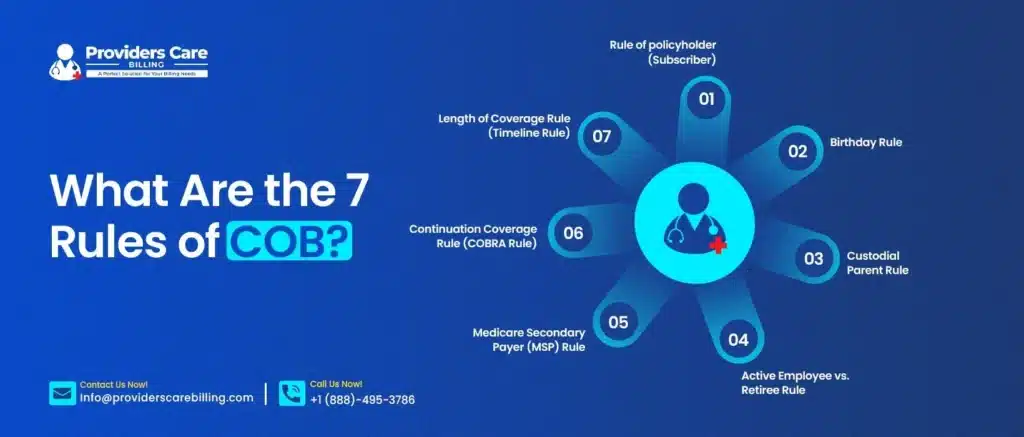
1. Rule of policyholder (Subscriber)
The first payer is the insurance plan for the patient as an active employee or as the primary policyholder. Any coverage on which the patient is reported to be a dependent becomes secondary. It is one of the most prevalent rules that are used in COB in medical billing.
2. Birthday Rule
The birthday regulation will be used on the dependent children who will be insured by both parents. The earlier the parent (by months and days, but not years) in the calendar year, the greater the priority in the plan. This regulation makes the insurance coordination of benefits easier for families.
3. Custodial Parent Rule
Where there is a divorce or separation, the insurance of the custodial parent is normally primary in cases of dependent children. When joint custody is provided, the birthday rule comes into play to decide the order. The normal coordination of benefits COB guidelines can be superseded by court orders.
4. Active Employee vs. Retiree Rule
The active employee plan is paid instead of the retiree insurance in the case of a patient who is a working employee with coverage and a retiree insurance as well. The insurance structure of the COB process covers retirees on the second level. This eliminates duplicate and incorrect billing.
5. Medicare Secondary Payer (MSP) Rule
In the case of Medicare, the order of payer is based on the size of the employer and employment status. When there are 20 or more employees, the employer plan takes precedence, followed by Medicare. These regulations are very controlled and important in the compliance with COB medical billing.
6. Continuation Coverage Rule (COBRA Rule)
When the patient has COBRA coverage or continuation coverage and an active employer plan, then the active plan is primary. COB health insurance regulations make continuation coverage a secondary option. This makes claims to be sequenced appropriately.
7. Length of Coverage Rule (Timeline Rule)
In case no other regulation defines the status of primary payers, the plan covering the patient for a longer time becomes primary. This regulation comes in as a tie-breaker in complicated COB claims situations. It maintains uniformity in cases where standard criteria are not applicable.
No longer lose money caused by coordination mistakes and slow second-party payments. Providers Care Billing LLC makes sure that the COB is correct in medical billing, the reimbursement is quicker, and the payer regulation is completely met.
Call us today to get a free consultation and get our experts to streamline your revenue cycle.
Medicare and COB Health Insurance Rules
MSP guidelines are difficult to stay the same; monitor them closely. Key 2026 updates and reminders:
- In cases where the employers have more than 20 employees, the employer plan takes priority, and Medicare comes second.
- When the number of employees in the employer is less than 20, Medicare is the key payer.
- When dealing with disability cases, the number of employees usually increases to 100.
Complete correct MSP questionnaires at the initial visit to a patient. Errors in the management of MSP are punishable and subject to recouping of reimbursement. Here at Providers Care Billing LLC, we carry out organized MSP check-ups in order to maintain ourselves.
Common COB Challenges in Medical Billing
COB introduces challenges even with clear workflows that may slow down payment and increase rates of denials.
Incomplete Patient Information
Patients can fail to provide secondary insurance on registration or fail to provide policy changes. This may lead to claim rejections whereby the primary payer identifies other coverage in its eligibility system.
Incorrect Payer Order
Claims may be sent to an incorrect insurer initially because of the incorrect use of the rules of COB. In case of incorrect sequencing, the payers reject the claim and request resubmission after proper COB practices.
Missing EOB Documentation
The primary payer should submit the EOB to the secondary insurers to pay. In case the EOB is not attached or sent in proper form, the claim is rejected or suspended.
Clearinghouse Rejections
Lost or expired MSP questionnaires may result in erroneous payment by Medicare and payment denials, which will result in audits and recoupment pursuant to federal regulations.
Confusion Between CO and COB
Most of these teams confuse the CO adjustment codes on remittance advice and COB. CO codes are contractual adjustments, COB payment orders. Their confusion results in mistakes in the workflow.
Eligibility Changes Mid-Year
Patients usually switch jobs and plans without notifying providers. Unless coverage modifications are confirmed before submitting claims, COB claims might be rejected as the policy is dormant or changed.
How Providers Care Billing LLC Solves COB Problems
We provide medical billing services at Providers Care Billing LLC:
- Checks of insurance status and eligibility.
- MSP compliance reviews
- Submission management of claims, secondary.
- Denial analysis and appeal.
- EOB reconciliation
- Revenue cycle optimization
Our team ensures:
- Faster reimbursements
- Reduced COB claim denial.
- Adherence to new federal guidelines.
- Transparent reporting
We understand that the direct effect of COB benefits on your bottom line. The fact that we have structured workflows relieves the administration of the burden and enables providers to focus on patients.
The Financial Impact of Poor COB Handling
When benefits in medical billing are improperly coordinated, there is the possibility of:
- 10–20% increase in denial rates
- Increased A/R days
- Refunds because of overpayments.
- Compliance audit risk
- Patient dissatisfaction
The workflows of the COB are optimized, which contributes significantly to the impact of revenue cycles.
Final Thoughts
The knowledge of COB in insurance and the ability to coordinate the benefits process and the appropriate application of the rules of COB can be a great boost to your revenue cycle performance. In the modern healthcare setting, with its changing landscape, proper COB management is essential for compliance and success.
Providers Care Billing LLC is willing to assist you in case your practice is facing COB related denials or delayed reimbursements. Today, we can find out how professional COB medical billing services can help to maximize your earnings and make operations easier and more efficient. Contact us now.
Frequently Asked Questions
What is COB in health care billing?
COB in medical billing specifies the order in which a patient is paid by an insurer in case he or she has more than one policy. It prevents reimbursement and payment inaccuracies.
What are the 7 rules of COB?
These seven rules include the policyholder rule, the birthday rule, the custodial parent rule, the active vs retiree rule, the Medicare Secondary Payer rule, the continuation coverage rule, and the length-of-coverage rule.
What is insurance coordination of benefits?
COB in insurance refers to the process in which more than one insurer divides the payment burden to ensure that the aggregate payment never exceeds the limit of 100 percent of the charges.
What is COB in an insurance claim?
On insurance claims, COB determines the order of primary and secondary payers before the payment of the claim.
How does EOB relate to COB?
The EOB demonstrates the way in which the main insurer treated a claim. When submitting the claim to the secondary payer, it needs to be attached in case of COB.