
CPT codes for physical therapy are used to record services and ensure proper reimbursements in physical therapy practices. CPT codes are developed by AMA, and they are the universal language of health care procedures. PT codes encompass all the first-time assessments to particular treatments. The right codes will guarantee compliance and the right payments.
Proper coding is essential: it leaves a clear record of treatment, and it will allow you to justify claims and obtain relevant reimbursements for your PT.
Providers Care Billing LLC assists PT clinics with code sets. Here, we discuss the most popular PT CPT codes, the ways to apply them, and the means of preventing mistakes. We will demonstrate how our knowledge will simplify the process of billing and maximize reimbursement.
Why Accurate CPT Codes for Physical Therapy Matter
Proper coding of CPT is not only about the paperwork, but it is also about income. All codes are associated with a certain service or procedure. These codes assist insurers in making decisions on medical necessity and payment. The appropriate code deters theft of claims. As an example, filing a low complexity evaluation as a high complexity one may result in an audit or rejection. Proper coding will connect documentation to service, which will establish an accurate treatment record and establish trust with the payers.
Current Guidelines: CPT codes and payer regulations are dynamic. Progress of codes is done yearly by the AMA, whereas policies are revised periodically by Medicare. In 2017, the previous 97001-97002 codes were substituted by CPT codes 97161, 97162, and 97163 (low, moderate, and high complexity PT evaluation). It is important to keep up with the times; codes such as 97001 that are outdated lead to rejections. Our team will monitor updates to ensure that your billing is in accordance with the CPT and Medicare guidelines.
CPT vs ICD‑10 Codes
Procedure codes are used with diagnosis codes when making claims. ICD10 categorizes the condition of the patient (medical necessity). CPT codes for physical therapy describe the therapy. As an example, a sprained ankle will have a code of S93.4, and the PT service will have a CPT code. Both are required on claims. We assist in the pairing of diagnoses to the procedures to avoid being denied due to the miscoding or the omission of connections.
Physical Therapy Evaluation Codes (97161–97164)
Each new patient should have a first examination. Current evaluation codes are complex based on the complexity:
97161- Low complexity: approximately 20 minutes, few decisions, 1-2 deficits.
97162- Moderate: 30 minutes or so, moderate judgment, various deficits.
97163: High level: approximately 45 minutes, high decision-making, complex circumstances.
97164 – Re-evaluation: in the case of already existing patients where the condition or plan has changed significantly.
Each code demonstrates clinical presentation, history, and the complexity of the decision. History, findings, and plan should be documented, explaining the code. The evaluation codes are not time-based, but based on complexity rather than minutes. Your notes are sequenced with the appropriate CPT code through the work of our coders to verify that the services billed are the ones documented. Physical therapy providers can review resources and guidelines from the American Physical Therapy Association (APTA) to stay updated on therapy standards and billing.
Common PT Treatment & Procedure Codes
Once the analysis is conducted, you will apply different codes of treatment procedures. The most actively used CPT codes in the billing of physical therapy include:
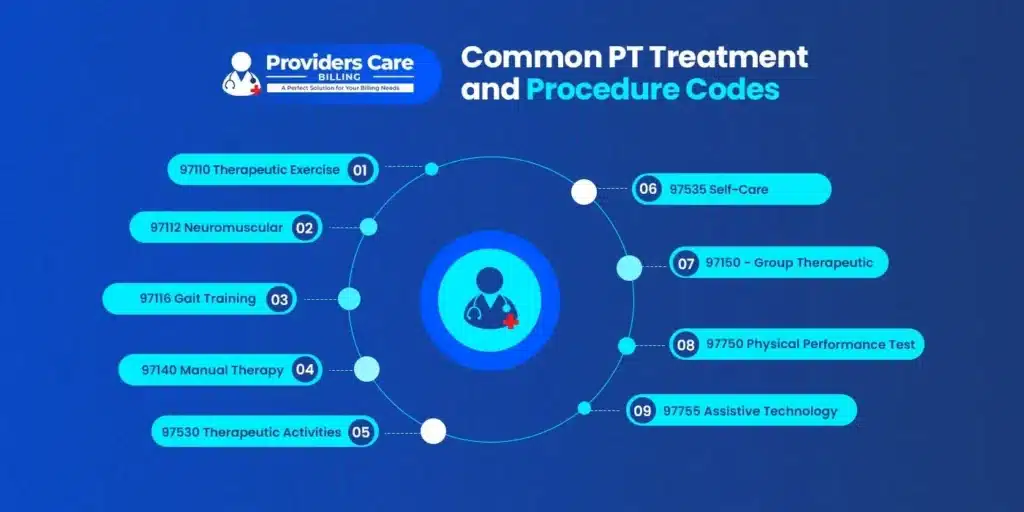
- 97110 Therapeutic Exercise: Strengthening, endurance, range of motion, or flexibility exercises. Billed on a 15-minute basis (have to comply with the 8-minute minimum regulation). As an example, shoulder mobility exercises that use resistance bands are charged under 97110. (Do not mistake this with Therapeutic Activities, see 97530 below.)
- 97112 Neuromuscular Re-education: Movement, balance, coordination, and proprioception re-training exercises, e.g., balance exercises after stroke. Billed in 15‑minute timed units.
- 97116 Gait Training (Locomotion): Practice to enhance walking, posture, and balance, which may involve practice with artificial limbs (prostheses) or assistive technology. Billed per 15‑minute unit.
- 97140 Manual Therapy (Manual Techniques): Clinical manipulations involving hands-on treatment to enhance movement, such as joint mobilization or soft-tissue work. (Example: a therapist forcing a tight group of muscles to stretch.)
- 97530 Therapeutic Activities: The dynamic exercises to enhance performance in all daily activities (e.g., bed mobility, transfers, lifting). Billed in 15‑minute increments.
- 97535 Self-Care/Home Management Training (ADL): Education about activities of daily living (e.g., dressing, grooming, adaptive techniques), or in the use of an adaptive device. Billed per 15‑minute unit. Such a code will tend to reimburse at a rate that is higher than 97110 since it entails greater skill and functional activities.
- 97150 – Group Therapeutic Procedures: An application in the case where two or more patients are provided with skilled care. This is a code without an expiry time (one code per patient per session). Do not charge 97150 when there was substantial one-on-one time provided; one should use individual codes.
- 97750 Physical Performance Test/Measurement: Standardized tests (with report) to record the functional (i.e., balance or endurance test) performance.
- 97755 Assistive Technology Assessment (With Report): Assessment of assistive equipment (e.g., walkers, wheelchairs).
Modalities (Physical Agents)
CPT is used in physical modalities with beginning numbers largely of 970xx. There are supervised (untimed) and constant attendance (timed) codes:
Supervised Modalities (charged per session):
- 97010: Hot or Cold Packs: the use of hot or cold packs to either heat up or cool down the skin.
- 97012: Mechanical Traction: motor traction of spine or extremity.
- 97014: Electrical Stimulation (Unattended): The TENS or NMES is used when the patient is not attended to continuously. Individual paraffin baths, 97016; paraffin wax, 97018; whirlpool, 97022; diathermy, 97024, etc.
Constant Attendance Modalities (15-minute time-based units):
- 97032 Electrical stimulation ( Attended): NMES sustained therapist attendance.
- 97033 Iontophoresis: electrical catheter of medication through the skin.
- 97034 Contrast Baths: alternating in hot/ cold water.
- 97035 ultrasound Therapy: deep tissue ultrasonic heating therapy.
- 97036 Hubbard Tank: whole body hydrotherapy immersion.
- 97039 Unlisted modality, which is only used with a special report.
For example, code 97014 constitutes an electrical stimulation that is administered through a machine in the presence of a patient without the direct attention of the therapist (only sets it up). Instead, use 97032, in case the therapist remains with the patient. Having been updated on the modalities that are to be counted in 15 minutes and those that are not, Providers Care Billing ensures that your clinic charges properly.
Orthotic and Prosthetic Management
Orthotic/prosthetic services are classified in codes of the 97760-97762 range: 97760 Orthotic management and training (first contact). 97771- Prosthetic training (every 15 min). 97762 – Orthotic/prosthetic follow-up check. Most outpatient PT clinics do not commonly use these, but they are necessary in the event you are able to fit braces or use prosthetic limbs in training. In the event of its applicability, we charge these with your bill. Providers Care Billing assists clinics in New York and California to correctly bill these services.
Other Noteworthy Codes
- 98975–98981 Remote Therapeutic Monitoring (RTM): Newer codes of monitoring of patient exercise compliance and body sensors in-home. (It is a developing field, and we can add them to it in case you are willing to provide a home check service.
- Taxonomy Codes: Taxonomy Codes Taxonomy Codes Although not CPT, remember to use the appropriate NPI taxonomy code of physical therapists (225X or 2251X0007X, e.g.) to claim. Providers Care Billing can help to get the right provider taxonomies to ensure that the payer systems identify you correctly.
Key Billing Rules & Best Practices
There are strict rules in relation to physical therapy coding. Some significant guidelines are as follows:
- Timed vs. Untimed Codes: Timed codes (such as 97110, 97112, 97530) are paid by 15-minute intervals; untimed codes (such as 97014, 97150 group therapy) are paid in one instance. Timed codes must be properly tracked. As an illustration, on 97110, two units (each occupying 15 minutes) will be billed when you spend 25 minutes. There is no difference in coding the untimed codes that are charged in 1 minute or 30 minutes.
- The 8-Minute Rule: In the case of timed PT services, Medicare needs at least 8 minutes of treatment to charge one unit. Then apply this reasoning: 8 minutes and above = 1 unit; 23 minutes and above = 2 units, etc. Record detailed records of start/stop times of every intervention. We have suggested an automated rule calculator or EHR timestamping. Providers Care Billing also cross-checks units to confirm that the rule is not violated.
- Modifiers:
- GP Modifier: GP Modifier is mandatory at Medicare to mark the plan of care for Physical Therapy. There are numerous practice-management programs that will automatically include GP to PT CPT codes, which is why it is necessary to pay attention to whether it can be found on every claim.
- KX Modifier: The KX modifier is used when the therapy limit of Medicare exceeds the annual payment (approximately 2,010 dollars a year) in the case of PT and SLP (commonly used together). KX verifies that it is medically necessary to continue services and prevents rejection. It is necessary to keep a running record of the cost of therapy.
- 59/XE/XP Modifiers: 59/XE/XP modifiers are used when you offer more than one individual service during a single session to indicate that these services are not related and therefore should not be charged as one. This helps to avoid accidental edits.
- CQ Addition: In case a therapist is supervising the therapy provided by a Physical Therapist Assistant (PTA), append the CQ modifier to the therapy codes. PTA services are normally reimbursed on 85% of PT rates.
- Payer Policies and LCDs: Not to mention Medicare, local coverage determinations (LCDs) may be found in the private insurers and may influence therapy codes. Consider the rules of each payer on a regular basis. The LCDs and payer policies are stored in a database maintained by our team, with any restrictions indicated, including frequency limits or stripped codes.
- Documentation: CPT codes are to be accompanied by detailed notes. Document patient improvement, certain exercises or activities undertaken, duration of time, and patient response. In the case of 97140 manual therapy, e.g., what type of joint or muscle techniques? Denials are usually caused by poor documentation. Providers Care Billing provides checklists and chart audits to define the gaps before the submission of claims.
- Common Pitfalls:
- Misuse between 97110 and 97530: When 97110 is billed instead of dynamic functional activities, it can lead to undercharging.
- Overbilling Time: Do not bill more than the recorded time will permit. When 30 minutes of 97110 is registered, you cannot charge three units (which would need at least 38 minutes).
- Group Billing: 97150 is only applicable to group therapy. Provided the therapist gives a considerable amount of time to each patient in a group, then that should be recorded as individual therapy.
Many claim denials occur due to incorrect coding or documentation mistakes. Clinics can avoid these issues by understanding Common Medical Billing Errors and How to Avoid Them, which helps identify problems that affect reimbursement.
How Providers Care Billing Supports Your PT Practice
Physical therapy medical billing is complicated. Providers Care Billing LLC offers the services of PT and rehab billing; therefore, we have knowledge about the specific CPT codes and regulations of this area. Our services include:
- Proper CPT/ICD Coding: We determine the most suitable CPT codes for any therapy session and match them with the appropriate ICD-10 diagnosis codes in order to record medical necessity.
- Effective Claim Submission: We can electronically file clean claims that are provided with all the necessary modifiers (GP, KX, CQ, etc.) and patient details, and minimize rejection.
- Denial Management: In the case of denied or audited claims, our team will research, rectify mistakes, and appeal to get the revenue back where necessary.
- Regulatory Compliance: We are on top of Medicare/AMA changes (e.g., annual updates to CPT codes, therapy cap policies, LCDs) to ensure your billing is never out of compliance.
- Reporting & Analytics: We deliver comprehensive revenue cycle reports, which reveal to you the precise reimbursement per code and denial patterns.
- Expert Support: Do you have a question concerning coding? Our registered coders can be consulted in difficult cases or documentation matters.
Do not get burdened with billing complexity. Providers Care Billing LLC is willing to make your physical therapy CPT coding and billing much easier. Contact our professional team today, have us audit your existing codes, and increase your revenue cycle.
Conclusion
Physical therapy code and billing may prove to be complex, yet to be successful, it is important to master the most important CPT codes for physical therapy and rules. Correct use of CPT codes in evaluation (97161-64), procedural (97110, 97112, 97140, etc.), modalities (97010, 97032, 97035), orthotics (97760-62), etc., will result in the ultimate clarity with the payers.
It is also essential to follow the rules of Medicare, such as using the 8-minute rule, utilizing the right modifiers (GP, KX), and not making such typical errors as the wrong application of group therapy codes. Providers Care Billing LLC may be your accomplice to this process. We keep up on CPT changes, have skilled coders reviewing your documentation, and handle claims filing and denial appeals. This allows you to focus on the care of patients and maximize reimbursements.
Frequently Asked Questions
What is the meaning of CPT code 97110?
CPT 97110 Therapeutic exercise, charged by the 15-minute billing (8 minutes minimum). It includes exercises that develop strength, range of motion, and flexibility.
What does CPT code 97014 cover?
Code 97014 refers to electrical stimulation (unattended), which is the application of TENS or NMES without constant attendants. In case you supervise it, then 97032 should be used.
What is an 8-minute rule in PT billing?
The 8-minute regulation is a Medicare regulation that says that you have to have at least eight minutes of a timed procedure to charge a unit, for each extra 15 min. You have to spend an extra 15 min. (e.g., 23 minutes will give two units).
Are PT services in need of such modifiers as GP or KX?
Yes. Add GP to show the PT Plan of Care to many payers, such as Medicare. Having surpassed the therapy limit of Medicare (approximately 2,010 annually), add KX as a way of indicating that services are medically necessary. Additional modifiers (59/XE/XP/CQ) might be required as well. Denials may be the result of misplaced or absent modifiers.