

Obesity is no longer perceived as a lifestyle issue but a chronic health condition that needs to be managed through formal clinical care, proper record keeping, and billing. To healthcare providers, CPT codes for obesity, diagnosis coding, counseling guidelines, and bariatric surgery billing are crucial in order to meet compliance, reimbursement, and audit security.
Providers Care Billing LLC assists the practice in the U.S. with end-to-end medical billing solutions negotiate the ever-changing environment of obesity billing, ICD-10-cm coding, and payer-specific demands, so income is ensured and patient care is a priority.
This is a comprehensive guide that disaggregates the codes of obesity, CPT codes, counseling services, weight management documentation, bariatric surgery billing, and Medicare-specific regulations, all in line with the present-day medical billing rules.
Understanding Obesity Coding in Medical Billing
Obesity is defined as a clinical diagnosis that is determined by the use of the BMI (Body Mass Index) and should be recorded appropriately to facilitate billing. Coding-wise, the coding of obesity needs to have both the diagnosis and the procedure code to support medical necessity.
The typical use of the CPT codes for obesity is:
- Preventive counseling
- Behavioral interventions
- Nutritional therapy
- Follow-ups on weight management.
- Bariatric surgery operations.
Proper billing facilitates the approval of claims and the security of providers in case of a payer audit. Clinical obesity definitions and BMI standards are based on CDC obesity guidelines
ICD-10 Diagnosis Codes for Obesity & Weight Management
The providers should choose the right diagnosis code before they can bill any CPT code for weight loss.
- Diagnosis coding in common involves:
- Obesity ICD‑10 codes (E66 series)
- ICD-10 code for weight management.
- ICD -10 code for weight loss management.
- ICD-10 code for weight loss drug management.
- DX code of weight loss or diagnosis code of weight loss.
These codes of diagnosis should correspond to:
- BMI documentation
- Treatment plan
- Counseling time
- Surgical eligibility (where necessary)
One of the most popular reasons that lead to the denial of obesity claims is the failure to connect the diagnosis and CPT coding properly.
CPT Codes for Obesity Counseling & Preventive Services
Preventive Counseling CPT Codes.
Among the most popular sets of CPT codes used in obesity counseling are 99401 and 99404, time-based preventive medicine counseling services.
- 99401- Individual counseling, approximately 15 minutes.
- 99402 -Individual counseling, approximately 30 minutes.
- 99403 – 45 minutes
- 99404 – 60 minutes
These services include lifestyle modification, behavior change, diet planning, and exercise counseling. This CPT code of 99401 is frequently inquired about in terms of reimbursement by many providers. Payer regulations, diagnosis connection, and documentation quality may influence the reimbursement.
Medicare-Specific Obesity Counseling Codes
G0447 Billing Guidelines
G-codes of obesity counseling are applied by Medicare. Description of G0447 CPT code: Face-to-face behavioral counseling of obesity, 15 minutes. The first covered will be once per week to eligible beneficiaries. The requirements are a BMI of 30 or higher, the presence of a primary diagnosis, and primary care.
Misuse of G0447 billing guidelines is one of the common audit triggers. Providers Care Billing LLC assists practices in complying.
Additional Quality & Reporting Codes for Obesity
A number of quality-reporting CPT and HCPS codes might be used:
- G8417 – BMI ≥ 30
- G8420 –BMI recorded and normal.
- 3008F-BMI measurement and recording.
When utilized properly, these codes assist with quality reporting, risk adjustment, payer scorecards, etc.
CPT Code for Nutritional & Weight Loss Counseling
An essential part of the treatment of obesity is dietary and nutritional counseling.
Services that are commonly billed for obesity are:
- CPT code of nutritional counseling.
- CPT code for weight-loss counseling.
- CPT code for obesity counseling.
- Obesity counseling CPT
These services should be assisted with: diagnosis codes, time records, treatment objectives, and progress monitoring.
Bariatric Surgery CPT Codes for Obesity
Bariatric surgery can be medically required in case of outpatients who are morbidly obese and fit the clinical requirements. It is essential to be very accurate in billing these procedures.
Most frequent bariatric surgery CPT codes:
- 43644 Laparoscopic gastric bypass.
- Gastric bypass CPT code
- 73047- Gastric sleeve CPT code: Laparoscopic gastric sleeve.
- Laparoscopic gastric banding CPT code.
- CPT code removal of the gastric band.
All the procedures should be consistent with the CPT code of morbid obesity, documentation of comorbidity, prior authorization, and payer-specific medical necessity requirements. Inappropriate bariatric surgery coding is among the most risky areas of bills; this is why a significant number of practices resort to outsourcing the task to specialists as Providers Care Billing LLC.
CPT Code for Weight Loss & Ongoing Management
Weight loss management is not a visit but a well-organized, long-term clinical service.
Providers may bill:
- CPT code for weight loss
- Obesity CPT code
- CPT code obesity
- Preventive counseling codes.
- E/M follow-up with appropriate use of modifiers.
To prevent denials and downcoding, proper sequencing of diagnosis codes and CPT services is required.
Common CPT Codes for Obesity, Weight Loss & Bariatric Services
| Code | Description | Primary Use |
| 99401 | Preventive obesity counseling (15 min) | Weight loss & lifestyle guidance |
| 99402 | Preventive obesity counseling (30 min) | Extended counseling sessions |
| G0447 | Medicare obesity counseling (15 min) | Behavioral therapy for obesity |
| 97802 | Nutrition therapy, initial visit | Dietary & weight management |
| 43644 | Laparoscopic gastric bypass | Bariatric surgery for obesity |
| 43775 | Laparoscopic gastric sleeve | Surgical weight loss procedure |
Common Obesity Coding & Billing Mistakes
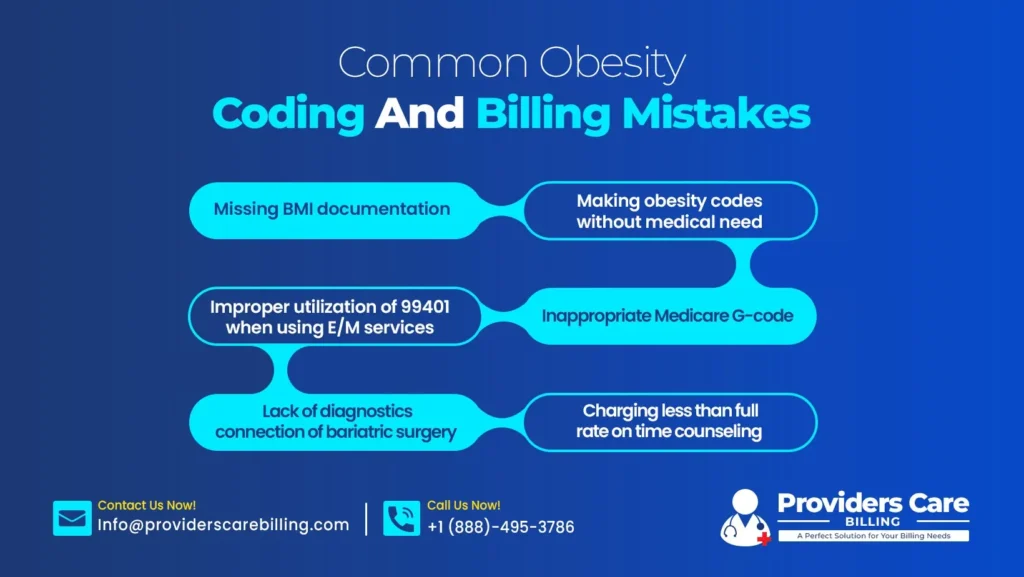
Even the practices that have been in use find it difficult to deal with obesity billing. Common errors include:
- Missing BMI documentation
- Making obesity codes without a medical need.
- Improper utilization of 99401 when using E/M services.
- Inappropriate Medicare G-code.
- Lack of diagnostic connection of bariatric surgery.
- Charging less than the full rate on time counseling.
Many of these issues are also covered in our guide on medical billing mistakes to avoid, which explains how small coding errors can lead to denials and compliance risks. Such errors result in revenue losses, audits, and delayed payments.
How Providers Care Billing LLC Supports Obesity Billing
Providers Care Billing LLC is a company that deals with correct billing of obesity, code compliance, and optimizing revenue.
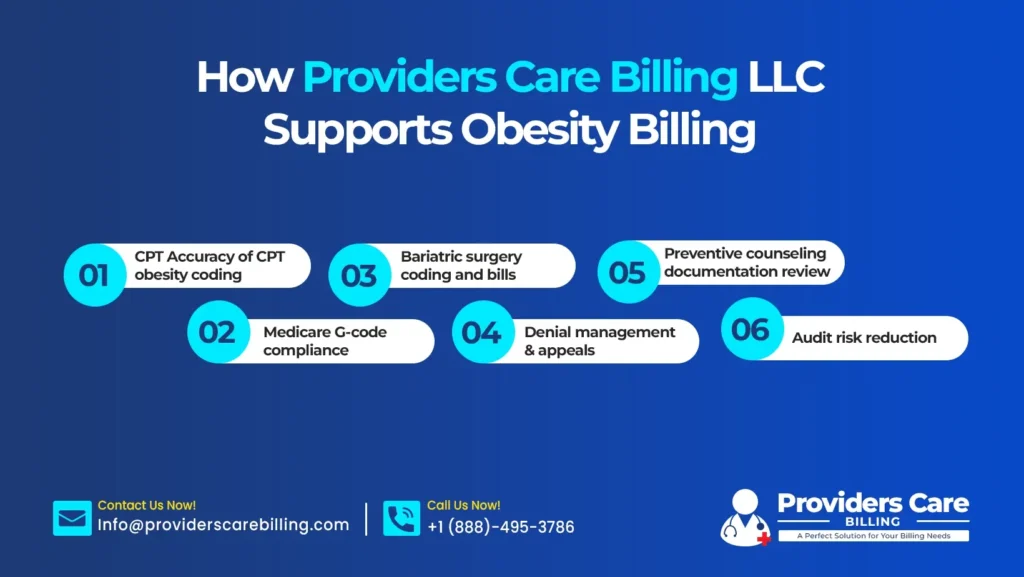
Our services provided include:
- CPT Accuracy of CPT obesity coding.
- Bariatric surgery coding and bills.
- Preventive counseling documentation review.
- Medicare G‑code compliance
- Denial management & appeals
- Audit risk reduction
- Continuous medical coding revisions and payer policy observation.
We assist practices to remain compliant, profitable, and stress-free in the provision of quality patient care.
Are you willing to streamline your obesity billing?
Contact Providers Care Billing LLC today and let us deal with all the complexity so you can attend to the patients.
Final Thoughts
There is much more to obesity billing and coding than assigning the right CPT or ICD-10 code; it requires clinical precision, regulatory awareness, and payer specific education. From preventive counseling to bariatric surgery, every service must be coded accurately to protect revenue and ensure compliance. For healthcare providers managing obesity and weight-management claims in New York, Providers Care Billing LLC delivers complete obesity related billing solutions that help practices remain compliant while avoiding financial losses.
Frequently Asked Questions (FAQs)
Can obesity counseling be billed as an office visit?
Yes, under the conditions of good documentation as an independent service and with time and diagnosis conditions.
Is obesity a billable medical condition?
Yes. Most payers have accepted obesity as a treatable medical condition when it is clinically documented.
Does Medicare pay for obesity counseling?
Yes, where the requirement is fulfilled, and counseling is done in approved settings among eligible patients.
Is bariatric surgery a claim that is denied more often than not?
They can be, most of the time, because of a lack of documentation, a lack of authorization, or wrong coding.
Why should I outsource obesity billing services?
Delayed payments and lost revenues. Coding rules are usually changed and audited due to errors in obesity coding, which is why errors are not tolerated.