

Did you know that the U.S. health care providers are losing billions annually because of claims denials that may be avoided?
A minimum of a 5-10 takeoff rate can radically disrupt cash flow. The denials can be dodged in most cases with the appropriate approach. If you face claim denials, increasing A/R days, or continuous resubmissions, in this article, we will discuss the Top 12 denial codes in medical billing. It explains their underlying causes and shows you how to develop an effective denial management process to protect your revenues.
Providers Care Billing LLC assists practices around the country to lower their denial rates, increase their clean claim ratios, and accelerate reimbursements with improved denial management.
What is a denial, and why do denial codes matter?
Denial is the rejection by the payer of a claim in its entirety or in part. Payers will give a denial reason code on why the claim did not work. Your code is the guideline for mending, appealing, or writing off the claim. An effective denial-management program monitors these codes, finds trends, and converts denials into dollars.
Who issues denial codes? Denial codes on ERA/EOB remits are sent by government payers (Medicare and Medicaid) and commercial insurers (Aetna, Blue Cross Blue Shield, and UnitedHealthcare). To update the policy of Medicare, refer to the Centers for Medicare and Medicaid Services policies.
Top 12 Denial Codes in Medical Billing (Description and Prevention Strategies)
The use of denial codes in medical billing allows a provider to reduce the recurrence of claim denials and enhance the accuracy of reimbursements. The following is a useful denial-code list, which all U.S. billing teams would be expected to memorize.
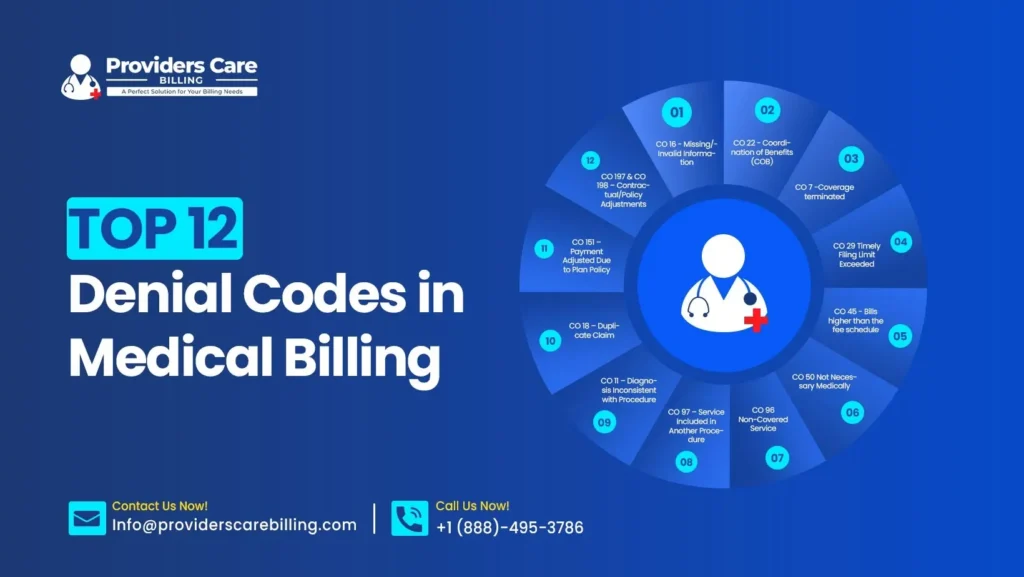
1. CO 16 – Missing/Invalid Information
The CO-16 denial code implies the lack of required information on the claim, its incompleteness, or invalidity. It may be incorrect patient demographics, invalid NPI, absent modifiers, or missing diagnosis codes. One of the most frequent denial codes is CO-16.
Prevention Strategy:
Apply front-end eligibility checking and claim scrubbers. Check required fields prior to filing a claim to reduce denials.
2. CO 22 – Coordination of Benefits (COB)
CO 22 is manifested through the case of having a different insurer as the main provider. The wrong payer or secondary insurance was forwarded with the claim before the primary payment.
Prevention Strategy:
Check the hierarchy of coverage every time a visit is made. Maintain your records of coordination of benefits in your system.
3. CO 7 – overage terminated
CO-27 refers to the fact that the patient was not under the plan on the date of the service. This is brought about by coverage termination or eligibility errors.
Prevention Strategy:
Pre-authorization of checks 24-48 hours prior to appointment and rechecking at check-in to prevent denials.
4. CO 29 Timely Filing Limit Exceeded
CO-29 indicates that the claim was filed after the filing deadline of the payer. The timely-filing limits among Medicare and commercial payers vary, and they are strictly followed.
Prevention Strategy:
Establish in-house deadlines before the payer. Monitor aging claims weekly.
5. CO 45 – Bills higher than the fee schedule
CO-45 denial code refers to the fact that the billed amount exceeds the amount that is contracted or allowed by the payer. It is an adjustment on a contractual basis, but not a total denial, which makes revenue projections hurt.
Prevention Strategy:
Make sure that payer fee schedules are current, and that billing software is programmed to bill with the correct contracted rates.
6. CO 50 Not Necessary Medically
CO-50 occurs in cases where the payer believes that the service is non-medical. It is usually triggered by poor documentation or incorrect coding of the diagnosis.
Prevention Strategy:
Make sure that medical necessity is recorded and corresponds to payer LCD/NCD policies and existing coding guidelines.
7. CO 96 Non-Covered Service
CO-96 indicates that the benefit plan of the patient does not cover the service. It is applicable to cosmetic, elective, or excluded procedures.
Prevention Strategy:
Check benefits before service and receive signed patient financial responsibility forms when necessary.
8. CO 97 – Service Included in Another Procedure
CO-97 indicates that the billed service is included in another procedure that has already been billed. This is mostly occasioned by the wrong use of the modifiers.
Prevention Strategy:
Apply the right modifiers when clinically appropriate and in accordance with the National Correct Coding Initiative edits.
9. CO 11 – Diagnosis Inconsistent with Procedure
The use of the ICD-10 diagnosis fails to warrant the procedure completed by the CPT/HCPCS, which results in the appearance of CO-11. It is a common reason for denials in specialty practices.
Prevention Strategy:
Pre-check diagnosis and procedure coding and routine coding audits.
10. CO 18 – Duplicate Claim
CO-18 indicates that the claim is similar to one that has been made before. This is frequently due to resubmission without verification.
Prevention Strategy:
Electronically track claim status and file corrected claims rather than new duplicates.
11. CO 151 – Payment Adjusted Due to Plan Policy
CO-151 is used to show the service was not provided due to policy rules or plan restrictions related to the payer. The payer contract should be reviewed frequently.
Prevention Strategy:
Maintain payer-specific billing requirements and revise your process of handling denials when policies are revised.
12. CO 197 & CO 198 – Contractual/Policy Adjustments
CO-197 and CO-198 tend to be connected with payer policy changes, benefit limits, or contractual limits. They vary by insurer.
Prevention Strategy:
Check the remittance advice provided by payers and match the billing practice to the current payer contracts.
Are You Ready to Cut On Claim Denials and to Increase Revenue? Contact Providers Care Billing LLC today to have a free denial analysis. And now, we will take a look at your best denial codes in medical billing and develop a custom revenue protection plan for your practice.
How Denial Management in Healthcare Prevents Revenue Loss?
Refusing to pay claims is not a safe administrative nuisance, but a direct revenue shock. A single percentage point of billing denials without a well-organized denial management procedure may cause serious financial damage, increased A/R days, and burnout among staff members.
A good denial management process transforms reactive correction into proactive prevention. Rather than resubmit rejected claims, the most successful revenue cycle groups would examine denial reason codes, identify common trends, and resolve root causes at the top, be it in registration, coding, documentation, or interpretation of the payer’s policy.
Why Are Medical Billing Denials Increasing in 2026?
Audits are becoming more restrictive. Medicare and commercial insurance companies have shifted their attention to medical necessity justification, misuse of modifiers, telehealth invoicing in line with requirements, accurate documentation, and preauthorization implementation. There are increased denial rates on practices that do not comply with the changes in CMS and AMA code.
How Providers Care Billing LLC Helps Reduce Claim Denials
- Full analysis of denials and monthly reporting dashboards.
- Live checking of eligibility before appointments.
- Innovative claim scrubbing technology.
- Approved coders with knowledge of new CPT and ICD-10 requirements.
- Successfully proven appeals management.
- Specialty-specific billing solutions.
Our clients typically see:
- A decrease in the denial rates in 90 days.
- A better-than-industry clean claim rate.
- A faster A/R cycle time.
- Greater net collection percentages.
We are not fixing denied claims, but we are stopping them.
Conclusion
Medical billing denial codes cannot be considered haphazard, but they have a pattern. You turn denials into revenue recovery opportunities when you analyze those patterns and take organized denial management. When your practice is making more medical billing denials or has difficulty with appeals, then it is time to find a partner who knows the code regulations as well as the behavior of the payers.
Frequently Asked Question
Define denial codes in medical billing?
The standard reason codes are the denial codes that insurance payers utilize to clarify the reasons why a claim was not paid or was paid partially. These codes are important in understanding what is right or wrong in order to avoid denial in the future.
What are the most frequently used codes of denials in medical billing?
The most popular medical billing denial codes are CO -16, CO -22, CO -29, CO -45, CO -50, CO -97, CO -11, CO -27, CO -18 and CO -96.
What can be done to avoid medical billing denials?
The prevention of denials may be achieved by performing eligibility checks and verifying the correct coding, document compliance, and claims scrubbing, as well as the denial management process.
Do Medicare denial codes differ from commercial payer codes?
All Medicare denial code adheres to CMS standards, though commercial insurers can add their own proprietary explanations to the standard codes.
What is denial management in the healthcare system?
Healthcare denial management is the process to identify, correct, appeal, and prevent claim denials systematically to enhance the revenue cycle.