
Imagine filing a claim today and receiving payment in record time, without lengthy phone calls, paperwork, and manual corrections. That is the strength of EDI in medical billing. With regulations changing annually and payer needs dynamically changing, Electronic Data Interchange is the support of a robust, compliant, and profitable revenue cycle in a healthcare setting.
Providers Care Billing LLC assists healthcare providers in the USA, including practices looking for medical billing services in New York, to streamline their EDI revenue cycle with secure, HIPAA-compliant, and denial-resistant workflows. This comprehensive manual covers the definition of electronic data interchange in medical care, its operation, the rules that apply to it, and ways in which your practice can use the most valid EDI solution.
What Is EDI in Medical Billing?
Electronic Data Interchange (EDI) refers to the computer-to-computer transmission of standardized healthcare data between providers, payers, clearinghouses, and insurance companies.
Organizations also transmit structured EDI files in formats like ANSI X12 or HL7, rather than mailing out paper claims or faxing eligibility requests. Payers’ systems automatically process these files and minimize errors and speed up reimbursements.
In short, EDI in medical billing:
- EDI eliminates manual billing.
- It standardizes communication.
- It enhances HIPAA compliance.
- It simplifies the electronic data interchange insurance deals.
Why EDI Is Critical to the Modern EDI Revenue Cycle
The EDI revenue cycle links all the processes of medical billing, such as patient eligibility, up to the claim payment posting. Practices that are not integrated with EDI experience greater denial rates, slow reimbursements, errors in manual entry, and increased compliance risk. Modern healthcare relies on EDI in medical billing for clean claims and stable cash flow.
How EDI in Medical Billing Works?
Electronic Data Interchange simplifies the overall billing procedure as it automates the process of provider clearinghouse payers’ communication. There is a standardized, HIPAA-compliant format of transaction made in every step to accelerate processing, enhance accuracy, and decrease claim denials. The sequence can be simplified as given below.
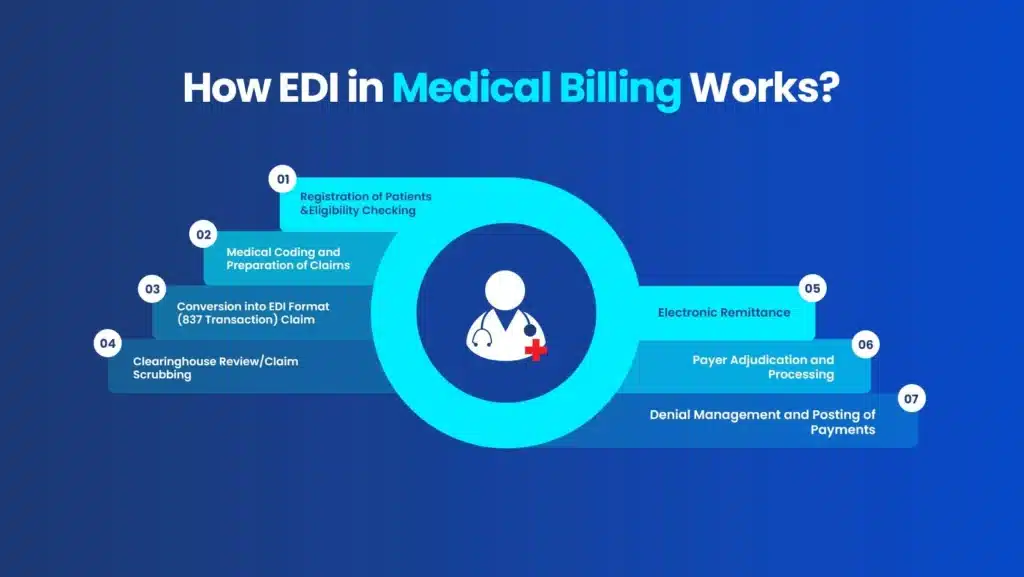
1. Registration of Patients and Eligibility Checking (270/271)
It begins with the electronic gathering and validation of the demographics and insurance information of patients. A request for eligibility is sent (270), and the payer responds with a coverage confirmation (271) detailing benefits, deductibles, copays, and other terms, reducing front-end errors.
2. Medical Coding and Preparation of Claims
Certified coders will designate appropriate ICD-10-CM, CPT, and HCPCS codes after services are rendered according to updated CMS and AMA codes. Correct coding facilitates conformity and produces clean EDI claims, which minimizes rejections.
3. Conversion into EDI Format (837 Transaction) Claim
Claim information is transformed into ANSI X12 837 files. This ensures compatibility with the payer systems and conformity to the HIPAA requirements of transactions and code sets.
4. Clearinghouse Review/Claim Scrubbing
Clearinghouse verifies the claim before it is submitted to the payer to ensure that there are no formatting mistakes, missing fields, or a mismatch in the coding. ERP EDI systems deploy automated scrubbing devices to identify problems before they arise to increase the first-pass acceptance rates.
5. Payer Adjudication and Processing
The payer checks the claim in terms of the coverage policies and medical necessity regulations. Payment status is determined under the automated adjudication process: full, partial, or denial.
6. Electronic Remittance Advice (835 Transaction)
Once adjudicated, the payer transmits an 835 file, which contains information about payments, adjustment and denial codes, which offers transparency and facilitates quick reconciliation.
7. Denial Management and Posting of Payments
ERA auto posts payments into the practice management system automatically. When denials arise, they are examined, amended, and sent back again electronically, and the revenue cycle remains good and streamlined.
EDI Transactions health care list
The compliance and optimization of EDI requires an understanding of the common transactions.
1. 837 – Application of claims (professional, institutional, dental)
2. 270/271 – Inquiry and Response of Eligibility (real-time check of coverage)
3. 835 – Electronic Remittance Advice (payments, corrections, refusals)
4. 276/277 – Claim Status Inquiry (follow up on pending claims)
5. 278 – Before The Processes Start (service approval before procedures)
6. 834 – Enrollment and Disenrollment (manage insurance rosters)
7. NCPDP Transactions – Pharmacy claims processing.
All these transactions have to adhere to HIPAA transaction and code-set requirements.
Standards That Govern Healthcare EDI
Healthcare EDI solutions have to meet the rigid federal requirements and standards of national data. These regulations secure the information of patients, maintain billing, and guarantee that all EDI transactions comply with HIPAA and CMS standards.
- HIPAA (Health Insurance Portability and Accountability Act)
HIPAA demands standardized electronic transactions. It also protects the health information of patients. Every insurance and medical billing should be in compliance with HIPAA Privacy, Security, and Transaction Rules.
- ANSI ASC X12N
ANSI X12N is a format of administrative EDI healthcare transactions, including 837 claims, 835 remittances, as well as 270/271 eligibility checks. Standardized formatting enables provider and payer systems to communicate without mistakes.
- HL7 & FHIR
HL7 and FHIR facilitate the interchange of clinical data. They enhance the interoperability of EHR systems and billing systems. Although EDI is used to handle administrative information, these standards enhance the integration.
- NCPDP
The National Council for Prescription Drug Programs (NCPDP) is an organization located in the United States that provides assistance and education to various stakeholders.
Benefits of EDI in Healthcare
The EDI profits are more than just prompt claim filing. An integrated revenue cycle accelerates payment, reduces administrative expenses, enhances compliance, and boosts financial performance.
- Faster Reimbursements
EDI claims reduce an enormous amount of time compared to paperwork. The faster process of adjudication enhances cash flow and reduces accounts receivable days.
- Reduced Claim Denials
High-tech claim scrubbing programs identify coding mistakes, missing information, and formatting issues prior to submission. This increases first-pass acceptance and safeguards revenue.
- Improved Accuracy
Automated EDI eradicates manual repetition, which minimizes human error. Consistent data is maintained in the standardized files.
- Lower Administrative Costs
Naturalized eligibility checks, status queries, and posting remittances leave the staff free of daily chores. EDI will be a cost-efficient long-term commitment.
- Stronger Compliance
Standard formats are in line with HIPAA, CMS, and payer regulations. The outcome is a reduced number of audit risks and definite compliance with the regulations.
- Enhanced Data Security
Even the health information (PHI) is secure, as it is encrypted using protocols such as AS2 and SFTP. Safe integration reduces the risk of breach.
- Live Tracking Visibility and Reporting
EDI systems provide immediate claim status, denial trends, and payment data. Providers are able to speed up the financial decision-making and fortify the revenue cycles.
Ready to Optimize Your EDI Revenue Cycle?
You need fewer denials, quicker reimbursement, and full HIPAA compliance: it is time to revise your EDI strategy. Contact Providers Care Billing LLC now. Free Revenue Cycle Analysis Schedule. Find the most trusted EDI solution for healthcare providers.
EDI in Insurance: Why It Matters
Insurance EDI provides good communication between the payers and providers. Insurance carriers rely on EDI in medical billing to:
- Process claims efficiently
- Detect fraud patterns
- Automatic application of coverage rules.
- Promote value alternatives of reimbursement.
The absence of electronic interchange would overwhelm the processes of payers with manual workflow.
Common Challenges in EDI Healthcare Integration
Although EDI is time-saving, most organizations experience:
- EHR and practice management system integration issues.
- Rejections of the clearinghouses due to formatting errors.
- Varying payer requirements
- The lack of training of the staff.
- Late adoption of regulatory changes.
These problems can be resolved by collaborating with a professional medical billing company in medicine.
How Providers Care Billing LLC Delivers the Most Reliable EDI Solution for Healthcare Providers?
In Providers Care Billing LLC, we customize extensive EDI strategies to American practices.
Our EDI Services Include:
- Complete EDI healthcare integration.
- Validation and scrubbing of claims.
- Secure clearing house management.
- ERA auto‑posting
- Eligibility automation
- Denial trend analysis
- Before authorization processes.
- Compliance monitoring
We do not simply send claims; we streamline the whole revenue cycle.
Why Choose Us?
- HIPAA‑compliant systems
- Recent coding compliance (ICD-10, CPT, HCPCS)
- CMS rule monitoring
- Real-time reporting dashboards.
- Dedicated account managers
- High clean claim rates
With our team, the data exchange will be straightforward in case you require a good EDI solution with low denials.
Emerging Trends in Healthcare EDI Solutions (2026 Outlook)
The future of EDI includes:
- API and EDI Hybrid Models: Batch transaction and real-time access.
- AI-Powered Claim Scrubbing: machine learning identifies billing abnormalities in advance.
- Blockchain Security: blockchain records eliminate fraud.
- Value: Based Care Integration EDIC promotes quality reports and bundles.
- Cloud-based EDI Systems: scaling, inexpensive for tiny practices.
To be competitive in the billing strategy, it is important to be ahead of these trends.
Conclusion
The healthcare sector is changing rapidly. Claims made on paper and verified manually are a thing of the past. The EDI healthcare integration system has become a requirement for compliance, efficiency, and profitability. The risks of practices that do not modernize their EDI services are: high denial rates, slower reimbursements, regulatory penalties, and lost revenue. Providers Care Billing LLC is determined to provide safe, adherent, and scalable healthcare EDI solutions to enhance your revenue cycle, from beginning to end.
FAQS
What is the electronic data interchange in medical care?
Electronic Data Interchange (EDI) refers to the standard digital interchange of billing and clinical data between payers and providers, expressed in such formats as ANSI X12 and HL7.
What are EDI claims?
EDI claims are medical insurance claims that are in electronic form. They are provided in the 837 transaction format according to the HIPAA standards.
What do EDI files in healthcare mean?
EDI files are designed as digital files. They carry data of eligibility, claims, remittance, or authorization information that is passed on among healthcare entities.
Is medical billing EDI-mandatory?
Yes. HIPAA mandates covered entities to conduct claims, eligibility, and remittance using standardized electronic transactions.
What is the effect of EDI on the management of the revenue cycle?
EDI minimizes mistakes in manuals, accelerates reimbursements, cuts down on denials, and enhances tracking of claims- fortifying the complete revenue cycle.