

Did you hear how the loss of thousands of dollars per patient each year by health care providers can be caused by improper HCC coding? Poor documentation and coding gaps often lead to revenue leakage, which is why professional medical billing services and revenue cycle management (RCM) solutions are essential for financial stability.
Incomplete risk-adjustment documentation can lower reimbursements under value-based care models by up to 20%, according to industry estimates, thereby increasing the cost of care for healthcare organizations. That is why HCC Coding is no longer a matter of choice; it is a prerequisite to financial stability and compliance.
In this guide, we will discuss the meaning of HCC coding, its operation, the necessity, and its direct effects on healthcare reimbursement, compliance, and patient care outcomes.
What Is HCC Coding?
HCC Coding (Hierarchical Condition Category coding) is a risk adjustment coding model that is used by CMS (Centers for Medicare & Medicaid Services) to estimate the future medical care expenses of patients, depending on their medical conditions.
In medical terms, HCC is sometimes abbreviated as HCC; it is a system that classifies related diagnoses into medical categories that forecast the cost of healthcare.
In simple words:
HCC codes are used to assist insurance companies in estimating the risk of the patient and paying the providers accordingly.
What is the Medical meaning of HCC?
The question asked by many providers is: What is HCC medically?
HCC stands for “Hierarchical Condition Category”.
Breaking it down:
- Hierarchical- Conditions are ordered in terms of severity.
- Condition- According to recorded diagnoses.
- Category- Classified into risk categories.
The Medicare risk adjustment payment model is specifically known by the CMS HCC medical abbreviation, which is crucial for healthcare organizations.
Other typical search terms are:
- HCC medical abbreviation
- CMS/HCC medical abbreviation.
- HCC stands for medical
These are all the risk adjustment coding systems.
What Is HCC in Medical Coding?
Assuming you want to know what HCC is in medical coding, the answer is straightforward:
It is a system that links diagnosis coding and reimbursement risk scoring.
The process works like this:
- Chronic conditions are conditions that can significantly affect a patient’s risk adjustment factor.
- ICD-10 codes are assigned by a medical coder, who plays a vital role in determining the accurate risk adjustment for patient care.
- ICD-10 codes map to HCC codes.
- The risk score is calculated.
- Reimbursement is adjusted.
That is why proper HCC medical coding has a direct effect on practice revenue.
A Case Study: The Effect of HCC Coding on Revenue
A family practice clinic saw hundreds of diabetic patients, but only recorded a diagnosis of diabetes without complications. As their coder would later learn, particular complications such as neuropathy and nephropathy were not recorded.
Due to the failure to bill and code HCCs, the practice was reimbursed at a low rate.
Their risk adjustment score was better, and their reimbursement was greatly improved after the documentation and coding processes were improved.
This demonstrates the importance of HCC medical billing and coding.
What Is an HCC Code?
An HCC code is a cluster of ICD-10 diagnosis codes of chronic or severe health conditions.
Examples include:
- Complicated diabetes
- Acute coronary syndrome, like Congestive Heart Failure
- COPD
- Cancer
- Long-term Kidney Disease
Patients are at risk differently depending on the condition.
Not every diagnosis that is covered under the HCC codes, but only those that impact the long-term healthcare costs, is included.
Knowing about Hierarchical Condition Categories
The Hierarchical Condition Categories (HCC codes) are hierarchical.
When a patient has many non-degenerative conditions, only the most severe group is considered.
Example:
If a patient has:
- Diabetes free of complications.
- Complicated diabetes.
Only the more serious type is factored in. This will avoid payment duplicates and ensure a clean code.
Why HCC Coding Is Important?
Learning about HCC coding is one way practices can recognize their financial and compliance implications.
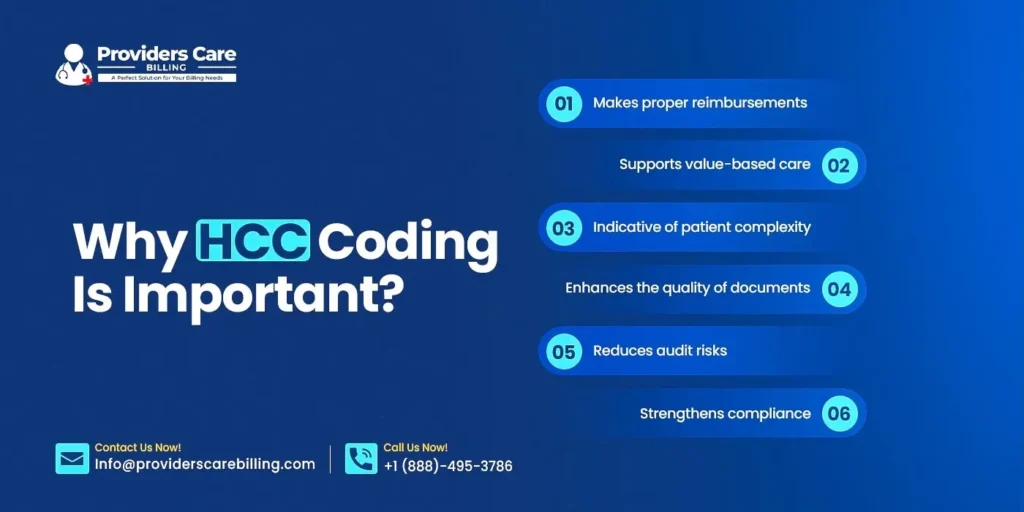
The importance of HCC coding is that it:
- Makes proper reimbursements.
- Supports value-based care
- Indicative of patient complexity.
- Enhances the quality of documents.
- Reduces audit risks
- Strengthens compliance
Providers can be paid less than the real value of complex patients unless they are coded correctly with HCC.
HCC Medical Billing and Coding
The HCC medical billing and coding workflow generally includes:
Documentation
Providers are required to write down:
- Chronic conditions
- Disease status
- Treatment plans
- Monitoring activities
Coding
Coders assign:
- ICD-10 codes
- HCC mapped conditions
- Risk categories
Claim Submission
Claims are filed with regard to patient complexity.
Risk Adjustment
CMS is a reimbursement risk score.
This renders HCC coding to be a very important component of Revenue Cycle Management Services.
Cases of Common Conditions, which necessitate HCC coding
The typical diagnoses that will affect the health care reimbursement of HCC include:
- Diabetes
- Heart disease
- Cancer
- COPD
- Depression
- Obesity
- Long-term Kidney Disease
Such conditions should be reported on an annual basis to ensure risk scores.
What Will Be the Consequences When HCC Coding is Mismanaged?
Poor HCC coding can cause:
- Revenue loss
- Compliance risks
- Audit penalties
- Incorrect risk scores
- Payment delays
This is the reason why experienced Medical Coding Services are significant in accuracy.
The most important elements of Proper HCC Medical Coding
Powerful HCC medical coding relies on:
1. Complete Documentation
Providers must document:
- Condition status
- Treatment plan
- Monitoring
- Evaluation
The MEAT criteria are frequently recalled and used to remember them:
- Monitor
- Evaluate
- Assess
- Treat
2. Annual Recapture
HCC conditions should be reported on an annual basis.
Otherwise, the risk score will be reset.
3. Coding Specificity
The coders need to select the most specific ICD-10 codes.
HCC Coding and Value-Based Care
HCC coding is highly needed in value-based healthcare.
Why?
Since reimbursement depends on:
- Patient complexity
- Disease burden
- Care quality
- Risk factors
Practices with complex patients will not seem financially productive without being properly coded.
What Is HCC in Medical Coding vs Traditional Coding?
Traditional coding is concentrated on:
- Services performed
- Procedures billed
HCC coding focuses on:
- Patient conditions
- Risk levels
- Future cost predictions
One cannot exist without the other to be fully billed.
Most practices are not capturing all HCC conditions, which can lead to significant revenue loss.
Contact us today for a comprehensive HCC coding review and uncover missed reimbursement opportunities.
Common HCC Coding Mistakes
Common errors in HCC billing and coding are:
- Missing chronic conditions
- Using unspecified ICD codes
- Lack of documentation
- Failure to update yearly diagnoses.
- Ignoring MEAT criteria
Poor compliance and revenue are avoided.
The role of the Medical Billing Company in HCC Coding
Professional medical billing companies assist providers in enhancing the accuracy of HCC by:
- Documentation audits
- Coding reviews
- Risk adjustment analysis
- Provider education
- Compliance monitoring
Providers Care Billing LLC, Medical Coding Company, and Revenue Cycle Management Company are some of the organizations that incorporate HCC optimization into Medical Billing Services in Illinois, workflows, and processes in order to assist practices in obtaining proper reimbursements.
Technology Applied to HCC Health Care Coding
The HCC of health care coding in modern times frequently employs:
- Risk adjustment software
- Coding analytics tools
- Documentation prompts
- AI coding validation
- EMR alerts
Technology minimises human error and enhances capture.
Best Practices in the Enhancement of Accuracy of HCC Coding
In order to enhance the performance of HCC coding:
- Record chronic illnesses annually.
- Educate the risk adjustment by the training providers.
- Audit charts regularly
- Use coding specialists
- Monitor risk scores
- Enhance documentation procedures.
There is success in consistency.
The role of providers in HCC Coding
In medical coding success, providers are the most significant in HCC.
They must:
- Document clearly
- Specify disease status
- Update conditions annually
- Avoid copy-paste errors
- Support coding accuracy
The initial stage of coding is documentation.
HCC Coding and Audits
CMS is very keen on HCC medical billing and coding.
Audits often focus on:
- Documentation support
- Coding accuracy
- Risk score justification
- Upcoding prevention
There is a protection of practices in accurate documentation in case of an audit.
Future Trends in HCC Medical Coding
The future of HCC medical coding is changing and developing with:
- AI-assisted coding
- Predictive risk scoring
- Immediate documentation notifications.
- Computerized regulatory audits.
- Expansion of value-based reimbursement.
Best practices that embrace these tools will remain cost-competitive.
Conclusion
Learning the meaning of HCC coding and its importance is paramount to healthcare professionals working in value-based reimbursement settings. Proper coding of HCC guarantees effective risk adjustment, better accuracy of reimbursement, compliance, and accurate representation of the actual complexity of the patient population.
It is putting practices at risk of revenue loss and exposing them to compliance issues without the correct coding and documentation. By investing in appropriate documentation, regular audits, and professional code support, Providers Care Billing LLC will be able to protect the revenue and improve financial outcomes, and remain compliant with regulations.
FAQs
What is HCC coding?
HCC coding refers to a risk adjustment coding system that the CMS uses to estimate the cost of healthcare for patients, depending on the documented diagnosis.
What is the medical definition of HCC?
HCC is an acronym of Hierarchical Condition Category, a system of categorizing chronic conditions with regard to reimbursement.
What is HCC in medical coding?
It is a coding system that creates a connection between diagnosis codes and patient risk scores to be adjusted in reimbursement.
What is an HCC code?
An HCC code refers to a category used to classify serious or chronic conditions, used to modify risk adjustment payments.
Why is HCC coding important?
It guarantees the right reimbursement of the providers according to patient complexity.
What is the CMS HCC abbreviation of medicine?
It is the CMS Hierarchy Conditions Category risk adjustment model.