


Did you ever know that the healthcare practices may lose up to 15 percent of the annual revenue just because of the poor monitoring of billing performance and unpaid claims?
That is why it is essential to learn the medical billing reports to achieve financial stability and expansion as a provider. Practices are operating blindly as far as their revenue cycle is concerned, without adequate medical billing reporting. Providers can also refer to the official CMS guidelines on medical billing and claims to ensure accurate compliance and follow best practices.
We will describe what medical billing reports are, why they are important, their primary types, how they allow making better decisions, and how providers can utilize them to collect more and deny less.
What are Medical Billing Reports?
Medical billing reports are organized financial and operational reports that have been used to monitor the performance of claims, payments, denials, collections, and the overall activity of the revenue cycle. Such reports form constituents of successful medical billing analytics, and they assist the providers to learn where their money is entering the door and where it might be languishing.
Such reports normally contain:
- Claims submitted.
- Payments received.
- Outstanding balances can significantly impact the financial health of the practice.
- Denial trends.
- The turnover of the accounts receivable is a key metric for assessing cash flow.
- Billing statistics are essential for understanding reimbursement trends.
- Revenue cycle performance.
To put it in plain words, medical billing reports are a financial dashboard of a medical practice. These reports are a core part of professional Medical Billing Services, especially for practices seeking Medical Billing Services in Massachusetts to improve revenue visibility.
The Importance of Medical Billing Reporting
Most providers are also patient-centred and fail to understand the significance of billing report analysis. Nevertheless, issues such as delayed payments or regular refusals may remain unseen without adequate reporting.
The efficient billing reporting of medical practices assists in:
- Track revenue performance.
- Identify claim issues early.
- Improve collections.
- Reduce denials.
- Monitor staff productivity.
- Strengthen compliance.
Best practices in billing often combine reporting with expert Denial Management Services to proactively reduce claim rejections.
A Real-Life Story: How Reporting Saved a Practice
A small internal medicine clinic was experiencing a decreasing monthly revenue, although the number of patients was steady. Upon analyzing their revenue cycle reports, they found out that there was a high number of claims outstanding after 90 days as a result of not following up.
Their review of their aging report on medical billing enabled them to realize the problem and enhance follow-up processes. The collections also increased by almost 25 percent within three months.
This is an example that demonstrates how the correct Healthcare billing reports can identify hidden financial issues.
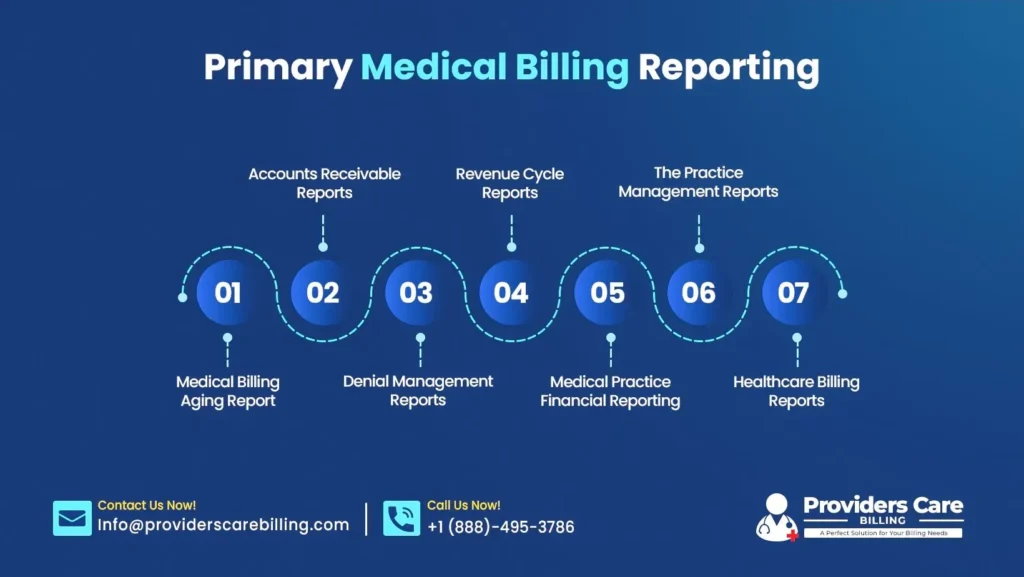
Primary Medical Billing Reporting
Knowledge of various formats of medical billing reports is useful in enabling practices to track each cycle of revenue.
1. Medical Billing Aging Report
Financial reports that are the most crucial include the aging report in medical billing. It displays claims that are unpaid based on their length of stay.
These usually include:
- 0–30 days.
- 31–60 days.
- 61–90 days.
- 90+ days.
This report is decisive when it comes to accounts receivable reports, as it points out delayed payments and prior file collections.
2. Accounts Receivable Reports
The Accounts Receivable Reports are the ones that take the responsibility of recording and tracking the accounts receivable transactions within the stipulated time. Unpaid balances with insurance companies and patients are followed in accounts receivable reports.
They help providers:
- Monitor outstanding claims.
- Determine the sluggish insurers.
- Improve AR follow-up.
- Reduce revenue leakage.
Good AR tracking enhances the accuracy of reports in Revenue cycle management.
3. Denial Management Reports
Claims that are denied have a direct impact on revenue. Denial management reports determine:
- Top denial reasons.
- Denial frequency.
- Payer patterns.
- Appeal success rates.
These reports contribute to the prevention of denial proactively and are critical in the current RCM dashboards when it comes to denial codes and trends. Understanding common reasons for claim denials helps prevent revenue loss and improve claim acceptance rates.
4. Revenue Cycle Reports
Revenue cycle reports give a full overview of the billing process, and include:
- Claims submission.
- Payment timelines.
- AR performance.
- Denial rates.
- Collection rates.
Successful Revenue Cycle Management Services depend on these reports.
5. Medical Practice Financial Reporting
Medical practice financial reports are concerned with the financial well-being of a practice.
They track:
- Total revenue.
- Net collections.
- Adjustments.
- Write-offs.
- Profitability trends.
Such reports assist the providers in making strategic financial choices.
6. The Practice Management Reports
Practice management reports offer financial and operational information that helps optimize cash flow.
Examples include:
- Appointment volumes.
- Provider productivity.
- Collection efficiency.
- Patient payment trends.
Such reports usually form part of a medical practice management report system.
7. Healthcare Billing Reports
The healthcare billing reports provide some of the summaries of the billing activities, such as:
- Total charges.
- Payments received.
- Patient payments vs insurance.
- Outstanding balances.
They give insight into the general performance in billing.
What is the purpose of Status Reports made by Payers?
One of the questions that is posed by the providers is: why do payers send status reports?
Status reports are sent by insurance companies to:
- Confirm claim receipt.
- Provide claim progress notifications to providers.
- Asking to get more details.
- Send rejections or acceptances.
These reports assist practices in keeping updated on the status of their claims and enhancing follow-up.
Medical Billing Analytics: Data to Decision
Current medical billing analytics is not just a mere reporting tool. They give practical details on revenue performance.
Examples include:
- Denial trend analysis.
- Payment speed tracking.
- Measurement of collection efficiency.
- Payer performance comparison.
Such understandings enable practices to achieve improvements with data.
RCM Denial Codes and Trends Dashboards
RCM denial codes and trends are visualized with the use of denial codes and trends in RCM dashboards by advanced billing teams:
- Top denial categories.
- Monthly denial patterns.
- Payer denial behavior.
- Appeal outcomes.
Dashboards simplify the complicated billing statistics.
PR1, PR2 and PR3 in Medical Billing
Many providers are asking; What is PR1, PR2, PR3 medical billing?
The following are codes of patient responsibility:
PR1:
The amount that he/she has to pay.
PR2:
The amount of coinsurance the patient owes.
PR3:
Copayment responsibility.
These will assist practices in understanding remittance advice.
Making a Difference in the Billing of Healthcare
Knowledge of the various kinds of billing is also useful in understanding reports in the right way.
Typical types of billing are:
- Insurance billing.
- Patient billing.
- Institutional billing.
- Professional billing.
- Cash-based billing.
They both need varied methods of reporting.
Sample Medical Billing Reports: What they normally indicate
The average sample medical billing report can consist of:
- Total claims submitted.
- Clean claim rate.
- Days in AR.
- Payment turnaround time.
- Denial percentages.
These are reports that constitute the basis of good financial management.
BEST EMR to use in Cash-Based Practice Reporting Features
Reporting capabilities sought by providers who are seeking the optimal EMR to practice cash-based care can include:
- Payment tracking.
- Patient balances.
- Financial summaries.
- Practice management report.
- Billing statistics.
Good EMR reporting enhances visibility in operations.
The way Billing Reports enhance Revenue Cycle Performance
Good Revenue cycle management reports assist practices in:
- Detecting bottlenecks.
- Improve collections.
- Reduce AR days.
- Monitor claim quality.
- Enhance payer relationships.
This causes greater economic security.
The way Medical Billing Companies make use of Reports to make results better
Advanced reporting by Professional Medical Billing Companies helps them to achieve better outcomes by:
- Constant monitoring of performance.
- Denial trend analysis.
- Payment tracking.
- Coding accuracy reports.
- AR improvement strategies.
In Providers Care Billing LLC, detailed reporting has been incorporated into total Medical Billing Services, Medical Coding Services, and Revenue Cycle Management Company processes to assist practices in acquiring full financial awareness.
Best Practice in the Use of Medical Billing Report
In order to achieve optimal value on medical billing reports:
- Review reports monthly.
- Track denial patterns.
- Monitor AR aging regularly.
- Compare payer performance.
- Enhance workflows with the help of analytics.
Better financial control is a result of regular reporting review.
Popular Causes of Common Mistakes Practices make with Billing Reports.
The most common reporting errors are:
- Ignoring denial trends.
- Not reviewing AR aging.
- Lack of monitoring payer performance.
- Ignoring write-offs trends.
- Not using analytics tools.
These can be avoided, and this enhances financial performance.
The Relationship between Revenue Cycle Management Reports and Growth
Practice growth is supported by effective reporting, which:
- Improving collections.
- Reducing operational waste.
- Getting more financial predictability.
- Underpinning the recruiting process.
- Guiding expansion planning.
Only accounting is not reporting; it is strategy.
The Future of Medical Billing Reporting
Technology is a forever-developing thing, and it is still developing in healthcare reporting.
Emerging new trends include:
- AI financial analytics.
- Predictive denial reporting.
- Automated dashboards.
- Real-time claim tracking.
- Smart RCM dashboards.
The modern reporting tool practices are a competitive advantage.
In case your practice has a poor reporting system or difficulty in tracking the revenues, the assistance of an expert can make a tangible change.
You might have to upgrade your reporting, enhance credentialing, enhance your billing workflows, or get Full Revenue Cycle Management Services, and the right partner can help you make changes in your financial performance.
Contact our billing professionals now and transform your medical billing reports into effective growth instruments.
Conclusion
Learning the medical billing reports and their primary types is crucial to financial well-being in the modern, ambiguous healthcare setting. Accounts receivable reports, denial management reports, revenue cycle reports, and numerous others are the most significant in revealing issues, enhancing collections, and reinforcing the financial performance. Active reviewing and utilization of reporting data can minimize denials, enhance efficiency, and boost profitability.
The collaboration with experienced billing professionals, such as Providers Care Billing LLC, will provide precise reporting, improved analytics, and improved financial performance due to the structured reporting and performance monitoring.
FAQs
What are medical billing reports?
They are financial and operational summaries that monitor the claims, payments, denials, and revenue cycles.
What is medical billing about an aging report?
It is a report of unpaid claims in terms of the duration of waiting.
What is the purpose of the status reports submitted by payers?
Payers make them inform providers about the status of the claim, approvals, or corrections that are necessary.
What are the denial management reports?
They follow rejected claims and determine the trends to minimize future rejections.
What are the revenue cycle reports?
They give a detailed description of billing, collections, AR, and payments.
What is PR1 PR2 and PR3 in medical billing?
These are patient responsibility codes that indicate amounts of deductibles, coefficients, and copays.