


Healthcare providers in the United States will experience stricter scrutiny of payers, accelerated electronic processing, and no tolerance towards late claims in 2026. One late payment can make a claim with full payment become a permanent denial. This is why the knowledge of medical billing time limits by state is not a choice anymore; it is a necessity to protect the revenue and ensure compliance.
Practices that partner with professional medical billing services can significantly reduce claim delays and missed filing deadlines by ensuring accurate claim submission and payer compliance.
As Medicare changes, state-based Medicaid regulations and commercial insurance policies continue to evolve, providers have to maintain a lead over timely filing regulations, denying patterns, and new regulations. The ultimate guide by Providers Care Billing LLC simplifies all your questions about the timely billing terms, state-specific deadlines, and the process of avoiding the expensive mistakes in filing in 2026.
What Are Medical Billing Time Limits by State?
Medical billing time limits by state are the maximum duration that a provider has to make a claim once the services have been delivered. These deadlines are different according to the payer, type of plan, and state regulations.
When a claim is not made within the stipulated period of time, it can be rejected in accordance with the provisions of timely filing, even in cases where the services were medically necessary and of the required code.
Is there a Time Limit to Medical Billing?
Yes, there is a definite limit of time. Every payer has a timely filing limit, which provides the duration that the providers have to present claims. These are strictly applied, especially to Medicare, Medicaid, and large commercial payers.
Also, another legal concept known as the statute of limitations is used to state how long a provider can take a patient to court to recover the payment.
Medicare Timely Filing Rules (2026 Update)
Medicare Timely Filing Limit
Original Medicare claims have a timeframe of up to 12 months (one year) before the date of service to file a timely claim with Medicare. This is a rule that is applicable to the majority of Part A and Part B services and is highly observed in the CMS regulations. Any claims that are filed more than 12 months are automatically rejected, whether based on medical necessity or appropriate coding.
The exceptions are usually very rare cases like retroactive Medicare eligibility, administrative mistakes, or something that is out of the provider’s control and is in compliance with the CMS reopening guidelines. Since Medicare does not issue regularly issued extensions, providers have to develop good internal controls to be in a position to make timely bills.
What Is the Timely Filing Limit for Medicare?
In the majority of cases, where the services are charged to Part B of Medicare, the providers will have to send in the claims within 12 months of the date of service. Any claims that are filed beyond this window are not allowed except in exceptional cases (e.g., retroactive eligibility). This means that non-payable claims are made in the event of failure to meet this deadline despite the requirement for medicine.
Medicaid Timely Filing Limits by State
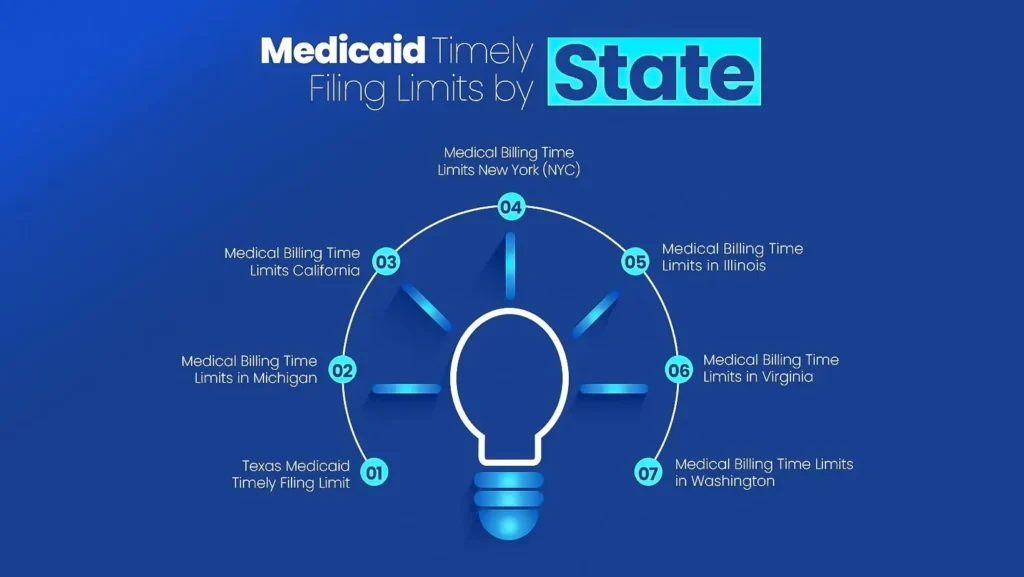
Texas Medicaid Timely Filing Limit
The normal claims allowed by Texas Medicaid are 95 days after the service date. The claims that are submitted at a later time are usually rejected unless they satisfy certain exception factors provided by Texas Health and Human Services (HHSC).
Medical Billing Time Limits in Michigan
Michigan Medicaid usually requires claims to be filed within 12 months of the date of service. However, managed care organizations may enforce shorter internal deadlines, which is why many healthcare providers rely on medical billing services in Michigan to ensure claims are submitted accurately and on time.
Medical Billing Time Limits California
In the case of California Medicaid (Medi-Cal), a regular period of timely filing is 6 months after the date of service, but this could be changed based on the type of claim and type of program. It is important to know the medical billing time limits in California due to the rigorous documentation requirements under Medi-Cal exceptions.
Medical Billing Time Limits New York (NYC)
Medicaid claims in New York must generally be submitted within 90 days from the date of service. However, certain exceptions may apply, such as cases involving retroactive eligibility or third-party liability. To avoid claim denials due to late filing, many healthcare providers rely on medical billing services in New York that understand state Medicaid regulations and ensure claims are submitted accurately and on time.
Medical Billing Time Limits in Illinois
Illinois has a 180-day window for Medicaid claims post-service. However, certain managed care plans may apply shorter internal deadlines instead of the standard state rule, which is why many providers rely on medical billing services in Illinois to ensure timely claim submission.
Depending on the level of participation of a provider, commercial payers like BCBS Illinois might require claims to be submitted within 180 days, making accurate and timely billing processes essential.
Medical Billing Time Limits in Virginia
The Virginian Medicaid demands that the claims be submitted within 12 months of the service date. Some of the types of providers or managed-care plans can impose deadlines that are shorter. Deadlines for commercial insurance typically have a range of between 90 and 180 days in Virginia.
Medical Billing Time Limits in Washington
Medicaid in Washington offers a 365-day window of claiming after the date of service. There can be other extension rules in the cases of retroactive eligibility and third-party liability. Washington commercial insurers generally require 90180 days of claims, depending on network arrangements.
Commercial Insurance Timely Filing Limits
The commercial insurers have their own timeframe for filing, which is usually different from the Medicare and Medicaid regulations. These deadlines, often outlined in provider contracts, typically range between 90 and 180 days after the date of service. Understanding Medical Billing Time Limits by State is essential, as missing these deadlines normally results in automatic rejections with limited possibilities of appeal.
What Is the Timely Filing Limit for UnitedHealthcare?
The filing limit of UnitedHealthcare ranges between 90 days and 180 days, depending on the provider participation agreement and the health plan itself. The deadlines that are unique to the contract are strictly adhered to by the in-network providers.
UnitedHealthcare also distinguishes between the deadline in initial claims, corrected claims, and reconsiderations, with each having a deadline.
Blue Cross Blue Shield Illinois Timely Filing Limit
The typical filing limit that Blue Cross Blue Shield Illinois provides is 180 days, which may depend on the provider contract and type of plan. Under network contract terms, the providers are expected to abide by the terms included in their contracts.
BCBS Illinois also requires proper coordination of benefits documentation in case of secondary insurance.
BCBS Massachusetts Timely Filing Limit
The range of filing limit of BCBSoft Massachusetts is usually 90 to 180 days, based on the participation of the providers and the policy provisions. There is more severe enforcement of in-network providers compared to out-of-network billing.
All claims should have fully and properly documented claims; failing which, BCBS Massachusetts may deny its adjudication.
Insurance Claim Processing Time
The difference between timely filling of the deadlines and claim processing time is the time of the payers to adjudicate once the deadlines have been filled.
According to federal law, electronic claims that are clean are supposed to be processed within 30 days, whereas paper claims can be processed within 45 days. Faster and correct claims cut down time and improve revenue cycle performance.
How Long Do Medical Providers Have to Bill You?
One of the frequent patient questions is the following: How long do health professionals have to bill you?
The answer depends on:
- Insurance contract rules
- State regulations
- Internal provider policies
In the majority of cases, the providers invoice the insurance parties and provide patient statements after the payer adjudication.
How Long Does a Hospital Have to Bill You?
The hospitals tend to file insurance claims within the payer deadlines. Nevertheless, the timelines of patient billing are subject to changes depending on the state and the internal policies.
In case of insurance refusal to pay based on the lateness of claim filing, patients can appeal against the bills, particularly when the lateness was not their fault.
Statute of Limitations for Medical Bills
Medical bills have a statute of limitations that defines the number of years a provider has rights to collect unpaid balances on a patient. This varies by state:
Many states: 3–6 years
Some states: up to 10 years
What is the Medical Bill Statute of Limitations?
It is the highest legal period that a provider or a collection agency may proceed with a lawsuit due to non-payment of medical debt. This is opposed to insurance’s timely filing limits.
Why Timely Billing Matters in 2026?
Payers are imposing deadlines vigorously with stricter audits and electronic monitoring of claims. Late claims often result in:
- Permanent denials
- Revenue loss
- Increased A/R days
- Compliance risks
Compliant, timely billing should be based on proper coding (ICD-10-CM, CPT, HCPCS) and compliance with updates provided by CMS.
Common Reasons Claims Miss Timely Filing Deadlines
1. Incorrect insurance information
Claim rejections are usually due to missed/incorrect patient information, e.g., demographics, insurance IDs, or policy numbers. Unless these errors are corrected promptly, the resubmission can fall outside the filing window of the payer. Late claims are often due to the failure of front-end verification.
2. Delayed Documentation from Providers
Lacking encounter notes or unidentified charts hold up coding and claim generation. Billing teams are not able to file clean claims in time without timely documentation.
Proper provider documentation is obligatory for efficient revenue cycle functions.
3. Coding Errors and Annual Code Updates
Incorrect ICD-10, CPT10 or HCPCS codes result in refusal and denials, which should be corrected. The fact that the codes are changed every year slows down submissions and resubmissions. Compliance with CMS and AMA updates accelerates the processing of claims and minimizes resubmissions.
4. Clearinghouse Rejections
Selected due to formatting or technical reasons, have to be corrected and sent immediately. Overlooking reports of clearinghouses may enable providers to overlook filing limits. Denial filing is prevented by reading rejection reports daily.
5. Staff Shortages or Workflow Gaps
Having understaffed billing units, they are unable to keep track of numerous payer deadlines between states. Loads of claims that are not automated are tracked to reduce missed submissions. The collaboration with an American revenue cycle management company keeps the supervision and deadlines in the right direction.
How Providers Care Billing LLC Prevents Timely Filing Denials
We are Providers Care Billing LLC that focuses on medical billing in the USA with a high level of compliance and a payer deadline tracker. Being a reliable revenue cycle management firm in the USA, we offer:
- Payer and state real-time deadline tracking.
- Submitting claims automatically within 24-48 hrs.
- Advanced claim scrubbing
- Full-service denial management services.
- Individual state Medicaid adherence.
- Regulatory updates in Medicare are monitored.
- Commercial payer contract analysis.
How Long Do Hospitals Have to Bill You? (Compliance Insight)
Patients will have their claims filed with hospitals, with a limit on the time required to file claims with the insurance provider, yet the limit varies. When a hospital fails to submit bills within the contractual timeframes, the patients might not pay the denials due to the delay on the part of the providers. Awareness of the billing window of a hospital assists providers in preventing compliance conflicts.
Partner With Providers Care Billing LLC Today
Do not allow filing of denials to drain your income.
Providers Care Billing LLC offers comprehensive revenue cycle and denial management, compliance, and full-spectrum services to U.S. providers. Contact us today for a free consultation and protect your practice against the expensive filing mistakes.
Final Thoughts
Due to the protection of the state billing limits, your practice is supported financially. Understanding Medical Billing Time Limits by State is crucial, because with constantly changing payer policies, CMS updates, and Medicaid policies, even a small delay with submissions may permanently ruin revenue. In addition to the 12-month restriction of Medicare, commercial, and Medicaid deadlines, it is necessary to be proactive and informed by the providers.
Compliance is hard, and denials are low because of timely billing, accurate coding, and tracking of updates at all times. By 2026 and beyond, the clinics that make the investment in a solid revenue-cycle system and professional management will shine among those still relying on the old manual systems.
Frequently Asked Questions
When is the deadline for filing Medicare?
In the majority of cases, the deadlining of Medicare filings is 12 months after the date of service.
Does medical billing have any time limit?
Yes, each state has specific Medical Billing Time Limits by State that providers must follow to ensure proper claim submission.
How long is the statute of limitations on a medical Bill?
Depending on the state, it goes on for between 3 and 6 years of seeking unpaid balances.
What is the maximum time taken by medical providers to bill you?
The payer filing deadlines should be observed, whereas the time of patient billing varies across states and policies.
What is the time of the filing deadline at UnitedHealthcare?
UnitedHealthcare typically takes 90-180 days to receive claims, according to the contract.