


Did you not know that multi specialty practices spend between 5 and 15 percent of collectible revenue annually?
The losses are attributed to billing inefficiencies, specialty code errors, and payer rules mismatches. Multi‑Specialty Medical Billing becomes more complicated, as well as the risk, when cardiology, orthopedics, family medicine, and behavioral health are under a single roof. In today’s world, a regulatory setup and proper medical billing and coding are vital. It promotes financial stability, compliance, and sustainable growth. This guide demonstrates how multi-specialty practices can simplify work, reduce denials, and increase reimbursement. It also shows how Providers Care Billing LLC offers quantifiable outcomes to healthcare entities throughout the U.S.
What Is Multi‑Specialty Medical Billing?
Multi‑Specialty Medical Billing is a process of coding and billing of practices providing services in multiple medical disciplines in one organization.
Multi-specialty billing needs: Unlike single-specialty billing, it requires:
- Intensive familiarity with specialty coding.
- Specialty knowledge of various medical billing rates.
- Contracting with different payers.
- Multiple provider coordination.
- Hi-tech denial-management billing systems.
Every specialty is associated with the CPT coding requirements, documentation standards, and reimbursement structures.
For example:
- Cardiology billing includes catheterizations, echocardiograms, stress tests, and global surgeries.
- Orthopedics needs the fracture care bundles and the implant documentation.
- CPT coding of behavioral health depends greatly on time.
- Primary care requires the correct E/M level choice.
Why Multi‑Specialty Medical Billing Is More Complex in 2026?
The billing codes and regulations evolve annually. Every year, CMS publishes updates to the Physician Fee Schedule, CPT, and ICD-10. There are also the Centers of Medicare and Medicaid Services and the American Medical Association guidelines that are modified, which have a direct effect on Multi‑Specialty Medical Billing.
Significant modifications that affect multi-specialty practice include:
- Revision of E/M documentation.
- Telehealth policy amendments.
- Clarifications of the use of modifiers.
- New international surgical package regulations.
- Increased audit scrutiny
When the practices are not updated in relation to the new regulations, they will face an increased denial and compliance risk.
Key Challenges in Multi‑Specialty Medical Billing
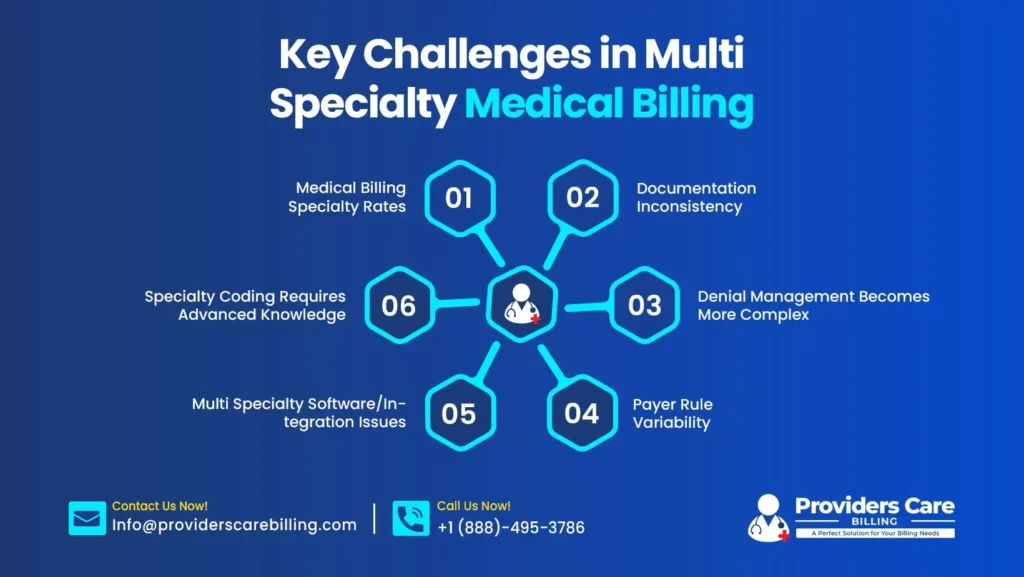
1. Medical Billing Specialty Rates.
The rates of billing differ depending on the specialty due to the disparity in RVUs, payer contracts, and the complexity of the procedure. Genuine surgical specialties tend to abide by international package regulations; primary care relies on accurate E/M coding. When a practice fails to comprehend these reimbursement differences, it could be the victim of underpayment or uneven revenue. Practices seeking medical billing services in New York can benefit from expert management of specialty-specific reimbursements. The management of the revenue cycle and billing will be critical to the management of revenue per specialty.
2. Specialty Coding Requires Advanced Knowledge
The correct specialty coding requires a comprehensive understanding of CPT, ICD-10, and HCPS rules in every field. Each of the cardiology, orthopedics, and behavioral health has its own documentation and modifier requirements. Denials can be made even because of small mistakes in coding. CPT programs enable certified CPT-coded services to ensure compliance and earn maximum reimbursement.
3. Payer Rule Variability
Various reimbursement regulations are applied to each specialty by insurance payers, which contributes to billing complexity. Policies of CMS are continuously revised, which influences documentation and the use of modifiers. Failure to monitor such updates will lead to denials and payments being made late. Constant regulation monitoring is the key to success.
4. Denial Management Becomes More Complex
The denial rates of multi-specialty are higher as the reasons differ across the disciplines. Denial management requires trend analysis at the specialty level and not a generic method. Unless there is systematic monitoring, repeated problems remain open. Revenue denial and decreased reimbursement cycle are safeguarded by proactive denial management.
5. Documentation Inconsistency
Encounters are usually coded differently by providers in other specialty areas, which poses a coding problem. Missing or incomplete records increase audit risk and underpayments. Billings are standardized with the current coding guidelines, which enhances accuracy in documentation. Periodic billing audit services assist in ensuring that there is compliance in departments.
6. Multi Specialty Software/Integration Issues
Multi specialty software needs to be compatible with EHRs and practice management systems. The inadequate configuration results in errors made during manual entries and decreases billing. Inferior automation and claim scrubbing software lessen inefficiencies. Scalable and compliant billing is carried out with the help of proper technology integration.
The best Medical Billing Process in Multi-Specialty Practices.
The Best Medical Billing Process for Multi-Specialty Practices
- Front-End Accuracy
Before services are rendered, insurance checks, benefit checks, and prior authorizations should be done.
- Specialty Specific Charge Capture
Services should be recorded by the providers in a clear and specific manner.
- Certified CPT Coding Services
The documentation is reviewed by certified coders to make sure that it adheres to CPT and ICD-10 standards.
- Claim Scrubbing
Claims are verified with CCI edits, MUE restrictions, and payer specifications.
- Electronic Submission of Claims.
The clearinghouses facilitate the transmission of clean claims to be reimbursed more quickly.
- Payment Posting & Reconciliation
The review of ERAs is to identify underpayments.
- Denial Management & Appeals
The rejected claims are systematic, rectified, and appealed.
- Reporting & KPI Monitoring
Clean claim rate, percentage of deny, days in A/R, and net collection rate.
These steps are incorporated in a well-organized medical billing system of revenue cycle management by Providers Care Billing LLC.
Ready to simplify your billing processes in a multi-specialty setting?
Knowledge is Power in Contact Providers Care Billing LLC, today, to receive a free revenue evaluation to find out how our specialty medical billing services can be of help to your practice by maximizing reimbursement, decreasing refuses, and safeguarding the economic performance of your practice.
We will take care of your revenue cycle, and you can concentrate on providing excellent patient care.
The Role of Multi Specialty Software
Contemporary multi-specialty practices require sophisticated software platforms, which combine Practice Management Systems, Electronic Health Records, charge capture solutions, reporting dashboard and claims scrubbing engines. Integration will minimize the number of errors in manual entries, enhance the compliance monitoring process, and heighten interdisciplinary efficiency. Providers Care Billing LLC collaborates with major systems to be able to guarantee the smooth integration and proper billing processes.
Compliance and Medical Billing Audit Services
Regulations and the code of health care are varied, and compliance is imperative since their rules and regulations keep evolving on a yearly basis. The practices should conform to CMS regulations, HIPAA specifications, and changing CPT and ICD-10 codes in order to prevent fines and loss of income.
Routine audit services remain in place to detect coding mistakes, documentation, and compliance risk before a denial or audit. Specialty coding is maintained in accordance with the payer policies through proactive internal audits. An appropriate compliance structure safeguards the reimbursement as well as the sustainability of the financial stability of the practice in the long term.
Why Is Medical Billing Outsourcing Growing?
There is a rapid growth of the outsourcing trend due to the rising complexity of coding and regulatory developments in the multi-specialty practices. Outsourcing provides access to accredited specialty coders without the expense of an increase in the in-house staff. It also enhances the clean claim rates by integrating the sophisticated denial management systems and software. The providers enjoy better revenue cycle management and accelerated reimbursements that enable them to attend more to the patients, as the specialists ensure the whole process of billing is done effectively and in compliance.
How Providers Care Billing LLC Supports Multi-Specialty Practices?
Providers Care Billing LLC is a company that offers a full scope of Multi‑Specialty Medical Billing in the United States. Our qualified staff members offer proper CPT coding, proactive denial management, and complete software support. We track CMS updates and changes in payer policies to make sure that the new regulations and code changes do not violate compliance with standards. We reduce denials and enhance financial performance by providing detailed reporting, audit services, and tailored revenue cycle plans to help practices improve their performance. It is not our complicated goal; it is to maximize reimbursement and allow providers to concentrate on providing quality patient care.
Final Thoughts
The Multi‑Specialty Medical Billing requires accuracy, compliance consciousness, and expertise in the particular specialty to ensure financial viability. As the rules of CPT, ICD-10, and CMS regulations keep changing, structured revenue cycle management strategies must be implemented in practices to remain competitive. Specialty coding, proactive denial management, and integrative multi-specialty software will be critical towards ensuring that reimbursement is maximized. Providers Care Billing LLC offers providers with full-fledged solutions to reduce the occurrence of denials, enhance compliance, and streamline the whole medical billing process.
FAQS
What are the reasons behind the variation in medical billing rates by specialty?
RVU, complexity of the procedure, and contract terms with the payers mean that specialty medical billing rates vary. Surgical and diagnostic specialities tend to reimburse unlike primary care services.
What is the significance of specialty in multi-specialty practices?
Specialty coding is a procedure that ensures that the procedures and diagnoses are in line with payer guidelines to ensure proper reimbursement. Lack of correct coding augments medical billing rejection and compliance danger.
What is the revenue enhancement of denial management medical billing?
Denial management establishes the root cause of claim rejection and eliminates the recurrence of errors. This enhances clean claims and enhances the speed of reimbursement.
What advantages are there to outsourcing medical billing?
Mediocre billing outsourcing offers the opportunity to find certified coders, sophisticated software, and regulatory oversight. It minimizes overhead and enhances the performance of the revenue cycle.
What is the need for medical billing audit services?
The audit services of medical bills identify the code errors, lack of documentation, and risks in compliance. Frequent audits safeguard the practices against punishment and loss of revenues.