


Did you realize that charging even a small copay to a Qualified Medicare Beneficiary (QMB) patient can initiate federal fines, mandatory refunds, and CMS audits?
However, QMB billing errors remain among the most frequent and costly errors healthcare providers commit. Knowledge of QMB in medical billing is no longer optional. Many providers now depend on medical billing compliance solutions to prevent costly violations. CMS’s tighter controls, automated eligibility checks, and an increase in the number of beneficiary complaints require the providers to learn to live by the QMB rules so as to remain afloat and safeguard revenue.
Providers Care Billing LLC takes everything that healthcare providers need to know about the QMB program in this guide. We discuss the coordination of Medicare and Medicaid, billing prohibition, best practices, and compliance strategies, thereby ensuring that you can make a billing without the need of facing violation.
What Is QMB? Understanding the Basics
QMB or Qualified Medicare Beneficiary is one of 4 savings programs of Medicare operated by state Medicaid agencies. When medical billing providers pose the question, what is QMB? the answer to this question is easy:
A QMB patient is a Medicare beneficiary whose Medicaid program pays their Medicare cost-sharing, such as deductibles, coinsurance, and copayments. This is regardless of whether the patient has QMB Medicare, QMB Medicaid, or both (dual eligibility).
What Is the QMB Program?
The QMB program assists low-income beneficiaries of Medicare in healthcare through covering:
- Part A premiums (when necessary) on Medicare.
- Medicare Part B premiums
- Deductibles
- Coinsurance
- Copayments
Due to this, numerous providers ask the question:
- What is a qualified Medicare beneficiary?
- What is QMB Medicare?
- What is Medicare QMB?
In every instance, the response is given in the same rule:
Medicare cost-sharing may not be billed to QMB patients by the providers.
QMB Medicare vs Medicaid: How the Coverage Works
A likely area of misunderstanding is QMB and the Medicaid organization.
Is QMB a full state medicaid program? No. This is critical.
What is the difference between full Medicaid and QMB?
It is necessary to understand what is meant by QMB and full Medicaid coverage. Full Medicaid can also cover other services, including long-term care or non-Medicare services, though the QMB program only protects Medicare recipients against costs. Confusion of these programs may lead to compliance errors and patient complaints, as well as audit risk. When the providers fully comprehend the mechanisms of association between QMB Medicare and Medicaid, they are able to make claims in accordance, prevent unlawful billing, and fully adhere to the CMS and federal regulations.
QMB Billing Rules Every Provider Must Follow
Federal Law that Defends QMB Patients.
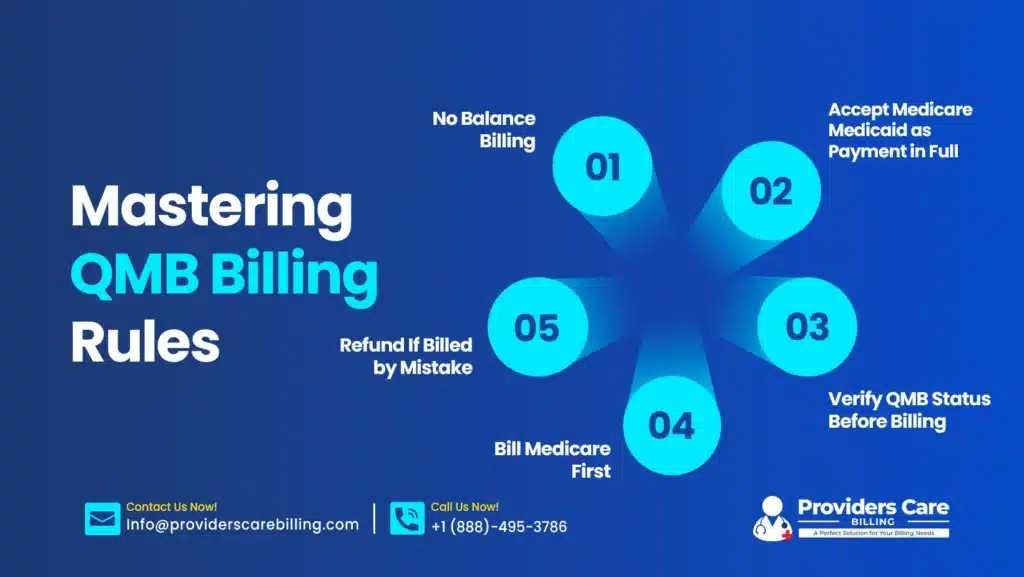
According to federal regulations and the CMS official QMB billing guidance, providers are prohibited from billing QMB beneficiaries for Medicare cost-sharing. Under the Social Security Act 1902(n)-1902(n)-3)-B statement, it is unlawful for the provider to the QMB beneficiaries:
- Medicare deductibles
- Coinsurance
- Copayments
This applies to:
- Participating providers
- Non-participating providers.
- Medicare Advantage carriers.
Although Medicaid may pay 0, the providers will be required to write off the balance.
What Does QMB Medicaid Pay For?
Medicaid does not substitute Medicare under the Qualified Medicare Beneficiary (QMB) program. Rather, it collaborates with Medicare by reimbursing the respective Medicare cost-sharing burdens of the beneficiary. This not only keeps potentially eligible patients in the system without having to pay out-of-pocket expenses on Medicare-covered services, but also keeps Medicare providers in line with federal billing and coding regulations.
QMB Medicaid pays for:
- Medicare Part A and Part B premiums.
- Medicare deductibles
- Medicare coinsurance
- Medicare copayments
When Medicaid pays an amount lower than the full Medicare cost-sharing amount, or does not pay at all, the provider must then write off the difference and, under no circumstances, should charge the patient.
QMB Plan in Medical Billing: How Claims Should Flow
The Medical Billing QMB plan has a rigid sequence:
1. Bill Medicare first.
2. The claim is processed under Medicare.
3. File a cross-over or second claim with Medicaid.
4. Receive mixed payment as full payment.
5. Write off any balance left.
Any failure to comply with this workflow might lead to:
- Refund demands
- CMS audits
- Civil monetary penalties
Identifying QMB Patients Correctly
Among the largest compliance risks, before the billing process, the inability to recognize QMB status is the largest.
How to Identify QMB Patients
Providers from Billing QMB should verify:
- HIPAA Eligibility Transaction System (HETS)
- Medicare Benefit Remittance Advice (RA)
- The portals of state Medicaid eligibility.
Key RA indicators include:
- CARC 209 Provider cannot bill the patient.
- RARC N781 -Patient is a Qualified Medicare Beneficiary.
Not performing on these indicators is a breach of compliance.
QMB vs SLMB: Key Billing Differences
Though both QMB (Qualified Medicare Beneficiary) and SLMB (Specified Low-Income Medicare Beneficiary) are Medicare Savings Programs, they differ with regard to the billing rules providers should comply with. The two should not be mixed up because compliance errors and the wrongful billing of patients might be caused.
The main distinctions that providers should know:
- QMB pays the Medicare premiums, deductibles, coinsurance, and copayments.
- SLMB only pays the Medicare Part B premiums.
- QMB individuals are not charged to pay any Medicare cost-sharing.
- SLMB patients can have deductibles and coinsurance.
- Wrong QMB billing can initiate audits, refunds, and fines.
These differences are recognized to assist providers in filing correct claims, preventing violations of balance billing, and not violating CMS regulations.
State-Specific QMB Concerns
The QMB regulations are federal, although the size of payment varies from state to state. Providers usually experience variations in:
- Medicaid payment rates.
- Crossover claim handling
- Processing timelines
Examples:
- QMB program in Florida
- Qualified Medicare Beneficiary program in Georgia.
- medical billing services in New York
Even though the states vary in this regard, federal billing rules are still used:
- You can’t bill the patient.
- The beneficiary cannot be involved in any payment disputes, but has to be dealt with through Medicaid.
Common QMB Billing Mistakes Providers Make
Even the practiced ones fail to catch mistakes due to gaps in the systems or mix-ups on the part of the staff. Common mistakes include:
- Pre-determination of correct billing copays.
- Comparing QMB and full Medicaid services coverage.
- Billing the Medicare Advantage QMB patients.
- Failure to refund excesses collected.
- Not training front desk and billing employees.
Practical Tips for Accurate QMB Billing
Following the law is essential, but applying smart billing strategies helps providers stay protected long-term. Here are actionable tips healthcare organizations should implement:
1. Verify QMB Status Before Every Visit
QMB eligibility can change monthly. Always verify through:
- HETS (HIPAA Eligibility Transaction System)
- Medicare Remittance Advice (RA)
- State Medicaid portal
Never rely on past records alone.
2. Flag QMB Patients in Your Billing System
Create system alerts or account flags for QMB beneficiaries. This prevents front-desk staff from accidentally collecting copays or deductibles.
3. Train Front Desk and Billing Teams Regularly
Many QMB violations happen at the front desk. Staff must clearly understand:
- QMB patients cannot be charged the Medicare cost-sharing
- Refunds must be issued immediately if collected in error
- Patients should not be sent to collections
Quarterly compliance training is strongly recommended.
4. Monitor Medicare Remittance Advice Codes
Billing teams should review RA indicators such as:
- CARC 209
- RARC N781
Ignoring these codes increases audit risk.
5. Maintain Written QMB Billing Policies
Create internal documentation explaining:
- How is eligibility checked
- How crossover claims are submitted
- How balances are written off
- How refunds are processed
Written policies protect you during CMS audits.
6. Perform Regular Internal Audits
Conduct periodic compliance reviews to ensure:
- No QMB patient was balance billed
- Claims followed the proper Medicare-to-Medicaid sequence
- Adjustments were correctly posted
Internal audits reduce the risk of federal penalties.
Best Practices for QMB Billing Compliance
Beyond basic rules, healthcare providers should adopt industry best practices to strengthen revenue protection and regulatory compliance.
- Implement Automated Eligibility Verification
Use billing software that performs real-time QMB checks. Automation reduces human error and improves claim accuracy.
- Standardize the Medicare-to-Medicaid Workflow
Follow this consistent claim flow:
- Submit a claim to Medicare
- Allow automatic crossover to Medicaid
- Post Medicaid payment
- Write off the remaining balance
Never deviate from this sequence.
- Separate QMB and Full Medicaid Workflows
Train billing staff to clearly distinguish between:
- QMB-only beneficiaries
- Full dual-eligible patients
Each category has different reimbursement expectations.
- Document All Write-Offs Properly
If Medicaid pays zero or partial cost-sharing, document:
- Adjustment reason codes
- Write-off explanation
- Supporting remittance documentation
This prevents recoupment issues.
- Respond Quickly to Patient Complaints
CMS closely monitors QMB complaints. If a patient reports improper billing:
- Investigate immediately
- Issue refunds within 30 days
- Document corrective action
Quick resolution protects your practice reputation.
- Stay Updated with CMS and State Medicaid Changes
QMB policies remain federal, but payment processing varies by state. Regularly review:
- CMS transmittals
- State Medicaid bulletins
- Medicare Advantage plan updates
Compliance is an ongoing responsibility
How Providers Care Billing LLC Supports QMB Compliance
Providers Care Billing LLC is a company that deals with billing compliance through Medicare-Medicaid coordination. You do not need to worry about being informed of the CMS updates and state Medicaid policies because we do that on your behalf.
Our services include:
- QMB eligibility checks processes.
- Medicaid and Medicare claim coordination.
- Scrubbing of claims driven by compliance.
- Administration of refunds and recoups.
- Staff training on QMB rules
- Support of documentation that is audit-ready.
Schedule a free consultation with Providers Care Billing LLC today. Allow our professionals to operate QMB billing, Medicare, and Medicaid payments, coordination and compliance error-free, ethically, and profitably.
Final Thoughts
The Qualified Medicare Beneficiary program plays a critical role in ensuring that low-income Medicare beneficiaries do not incur out-of-pocket expenses. To providers, it is essential to know about QMB billing regulations, Medicare and Medicaid coordination, and federal balance billing restrictions in order to remain in compliance and prevent punishments. Cooperation with a qualified billing company, such as Providers Care Billing LLC, will ensure that the QMB claims are done correctly, to the letter, and in the most cost-effective way possible, leaving you with the responsibility of providing quality services to your clients and ensuring that your revenue is not lost.
FAQS
What compliance protection can be used with QMB billing?
Bill to CMS protection, like verification of eligibility, staff education, automatic claim edits, and intermittent internal audits, are what prevent billing violations and keep you in compliance with CMS.
What is the significance of patient education in QMB compliance?
Educating QMB patients in their rights regarding billing and reading of Medicare Summary notices (MSNs) will allow them to identify cases of improper charges at the earliest stage, and therefore, enhance overall compliance.
What happens if a provider bills a QMB patient incorrectly?
If a QMB beneficiary is charged in error, the provider must promptly issue a refund, correct the claim, and document the corrective action for compliance purposes. Ongoing violations can trigger CMS audits, financial penalties, or repayment demands.
Are QMB billing rules different for dual-eligible patients?
Yes. Even when a patient qualifies for both Medicare and Medicaid, Medicare is billed first. However, QMB protections still prohibit providers from charging the patient any Medicare deductibles, coinsurance, or copayments, regardless of how much Medicaid reimburses.
What is the way providers determine the QMB status of a patient before billing?
Providers are required to attest to the status of QMB using HETS, verify Medicare Remittance Advice (RA) codes, and state Medicaid portals. Bill verification minimizes compliance risk and billing errors.