
Medical billing is a complicated process, especially when we’re dealing with terms like denied vs rejected claims. Both these may seem similar and show that the claim won’t be paid. But they aren’t interchangeable. And have different implications for healthcare providers. So, understanding the difference between rejection and denial in medical billing is very important. Because it ensures that claims are processed smoothly and that they’ll be reimbursed on time.
In this article, we’ll break down what these terms mean and how they impact your claims. And you’ll also know the best ways to handle them to minimize delays and maximize your payments.
What is a Denied Claim?
A denied claim happens after it’s been processed and reviewed by the insurance company. Once the payer has accepted the claim, they’ll review it thoroughly to check if the services match the patient’s benefits and the insurance policy. If something doesn’t line up or there are issues with coverage, coding mistakes, or policy limits being exceeded, the claim will be denied.
As a result, it has a big financial impact on a healthcare provider. It’ll hurt your revenue and cash flow. And on top of that, claim denial often requires extra time to fix the problems and resubmit it. This will cause more cost and delays to the process.
Common Reasons for Denied Claims
- Coding Errors: If there are some mistakes in the medical coding, like there’s a mistake in the ICD-10 code, then the insurance company can deny the claim.
- Lack of Pre-Authorization: There are some medical procedures that require prior approval from the insurance company. And if this approval isn’t obtained, then the chances are your claim will be denied.
- Non-covered Services: If the services or treatments aren’t covered under the patient’s plan, then the insurance company can deny the claim approval.
- Expired Insurance: You must also check your insurance coverage, as if it’s expired, the claim may be denied.
What is a Rejected Claim?
A rejected claim happens when there’s an issue with the claim itself. It usually occurs during the submission process. It’s like the claim doesn’t meet the basic requirements that are needed to even be looked at by the insurance company. And this can happen at two levels: the clearinghouse or the payer.
- At the first rejection, the claim is rejected at the clearinghouse level. It’s because the system found errors in the date. For example, it can find the wrong date of birth or special characters in the wrong place. The clearinghouse usually has checks in place to catch these mistakes. So they can be fixed before the claim is sent to the payer.
- On the other hand, if the claim passes the clearinghouse but still doesn’t meet the payer’s guidelines. Then it’ll get rejected at the payer level. At this point, the payer carefully reviews the claim. And if anything’s missing or doesn’t fit their requirements, they’ll reject it.
Need more about rejections: How Many Types of Rejections in Medical Billing?
Common Reasons for Claim Rejections
- Incorrect Information: In this type of claim rejection, a patient’s name may be misspelled, and incorrect policy numbers and billing codes may be included.
- Missing Documentation: If your claim is missing some necessary documentation, such as patient records or authorization forms, it may be rejected.
- Ineligible Provider: The claim could be rejected if a healthcare provider isn’t recognized by the insurance company. And if it is not authorized to perform the services.
For more detailed guidelines on claim submission rules and rejections, you can refer to CMS resources
Denied vs Rejected Claims: Key Differences
| Rejected Claim | Denied Claim | |
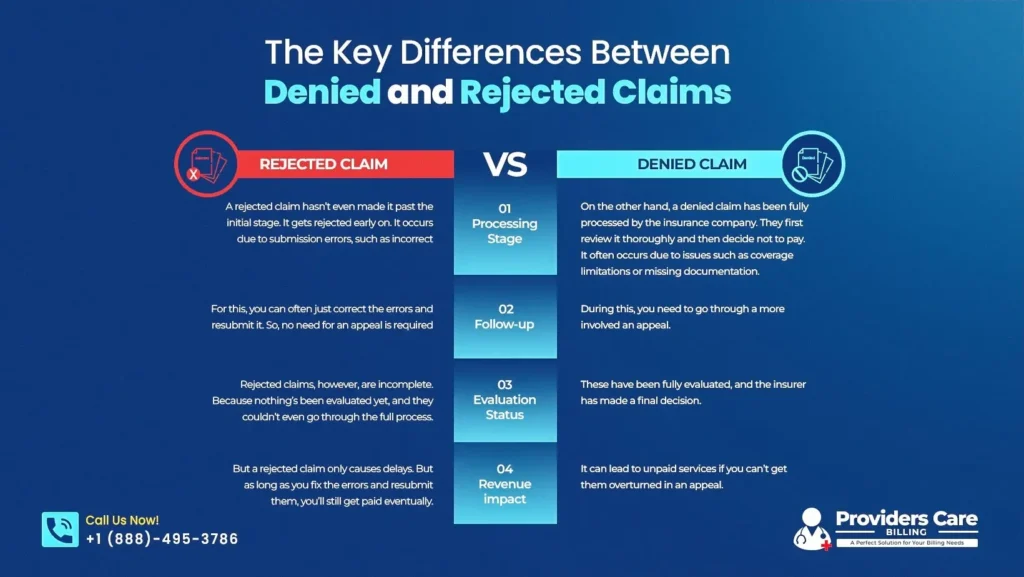
| 1: Processing Stage | A rejected claim hasn’t even made it past the initial stage. It gets rejected early on. It occurs due to submission errors, such as incorrect information or missing details. | On the other hand, a denied claim has been fully processed by the insurance company. They first review it thoroughly and then decide not to pay. It often occurs due to issues such as coverage limitations or missing documentation. |
| 2: Follow-up | For this, you can often just correct the errors and resubmit it. So, no need for an appeal is required | During this, you need to go through a more involved an appeal. |
| 3: Evaluation Status | Rejected claims, however, are incomplete. Because nothing’s been evaluated yet, and they couldn’t even go through the full process. | These have been fully evaluated, and the insurer has made a final decision. |
| 4: Revenue impact | But a rejected claim only causes delays. But as long as you fix the errors and resubmit them, you’ll still get paid eventually. | It can lead to unpaid services if you can’t get them overturned in an appeal. |
How to Prevent Denied and Rejected Claims?
As we’ve discussed the difference between denied vs rejected claims, now let’s understand how to prevent these issues in the first place.
Accurate Medical Coding
Always make sure that all codes are 100% accurate, such as diagnosis codes (ICD-10), procedure codes (CPT), and modifier codes. Because incorrect or outdated codes are one of the most common reasons for claim rejection and claim denial.
Verify your patient information
Before submitting any claim, you must double check that the patient’s information is correct and up to date. Because this can prevent errors that may lead to rejected claims.
Check Eligibility and Benefits
Before providing any services, you must check the patient’s insurance eligibility and benefits. This can help you avoid denied claims due to coverage issues.
Train Your Staff
This is the most important thing to make sure that your billing and coding staff are well-trained in the latest billing practices. This can reduce the chances of medical billing rejections and claim denials.
Timely Submission
The last, most important thing is that you always submit your claims as soon as possible. Because it avoids the risk of delays. This ultimately leads to denial claims due to limited time and expired authorization.
How Providers Care Billing, LLC Can Help
Managing denied vs rejected claims can be complex and time consuming . At Providers Care Billing LLC, We are specialized with years of experience in offering comprehensive medical billing services that include coding, RCM, insurance management and more. Our experts always make sure that your claims are submitted accurately and on time. And it minimizes the chances of claim rejection and claim denial.
We’re serving healthcare providers across the United States, including Massachusetts, New York, Illinois, and many others. So, if you’re one of those who are struggling with claim denial and claim rejection, contact us today. We offer a FREE consultation call to discuss your billing needs. And also help you streamline your claim process.
FAQs
Can I appeal a denied claim?
Yes, you can appeal a denied claim. If you’re sure that there was an error in the decision. But you’ll need to provide additional documentation or explanations to support your appeal.
How do I prevent rejected claims?
To prevent claim rejections, your patient information should be 100% accurate. Then submit all your necessary documentation and double-check your coding.
What is the main difference between denied vs rejected claims?
The main difference is that rejected claims are not processed due to errors in submission, while denied claims are processed but not paid due to coverage or policy-related issues.
Which takes more time to fix: denied or rejected claims?
Rejected claims are usually faster to fix because they can be corrected and resubmitted. Denied claims take more time because they often require a formal appeal process with additional documentation.
What causes most claim denials in medical billing?
Most claim denials happen due to lack of prior authorization, non-covered services, incorrect coding, or expired insurance coverage.